
Last updated: August 2026
Can I pursue gynaecology in the UK without PLAB after MBBS India?
Yes. Indian MBBS graduates and Foreign Medical Graduates (FMGs) can pursue gynaecology in the UK without PLAB through three routes — the MRCOG exam route, sponsored GMC registration, or the Portfolio Pathway. MRCOG is recognised by NMC India under the Third Schedule of the IMC Act — no NExT or FMGE required to practise in India after completing UK gynaecology training. MRCOG Parts 1 and 2 can be taken in India itself. Contact Career Voyage for a free profile assessment.
Gynaecology in the UK — officially Obstetrics and Gynaecology (O&G) — is a structured specialty training pathway governed by the Royal College of Obstetricians and Gynaecologists (RCOG). For Indian MBBS doctors and Foreign Medical Graduates, pursuing gynaecology in the UK without PLAB means training in NHS hospitals, passing the MRCOG examination, and earning a qualification recognised by NMC India under Part II of the Third Schedule of the IMC Act, 1956. Once you complete UK gynaecology training, you do not need to clear NExT or FMGE to practise in India. MRCOG can be started directly after MBBS and internship — no Indian MD OBG required, no NEET PG required, no PLAB required.
This guide covers the full pathway — from eligibility and MRCOG exam structure to without-PLAB routes, MSc entry options, and career prospects — specifically for Indian MBBS graduates and FMGs considering UK gynaecology as an alternative to NEET PG in 2026.
If you want to know whether you are eligible for gynaecology training in the UK, get in touch with Career Voyage. Our team will review your profile and tell you exactly which pathway and timeline fits your stage. Call us or send a WhatsApp message for a free consultation.
Why Indian Doctors Are Choosing Gynaecology in the UK Without PLAB in 2026?
The NEET PG situation in India is well known. Over 2.4 lakh doctors compete for around 70,000 PG seats every year. OBG is one of the most competitive specialties — cutoff ranks are high, government seats are scarce, and private colleges charge Rs 1–2 crore for MD OBG.
For Foreign Medical Graduates, the challenge is even more direct. If you completed MBBS from Russia, China, Ukraine, the Philippines, or any country outside India, you must clear FMGE — or from 2026, NExT — before you can practise in India. FMGE pass rates have hovered between 15–25% in recent sessions. Many qualified doctors are stuck without a practice licence despite holding an MBBS degree.
The UK route addresses both situations. There is no single entrance exam. There is no donation. You earn an NHS salary from day one of training.
What makes UK gynaecology specifically attractive:
- No NEET PG, no PLAB — MRCOG can be pursued directly after MBBS and internship
- NMC India recognised — MRCOG is covered under Part II, Third Schedule of the IMC Act
- NExT and FMGE exemption — UK is one of only five countries where completing PG exempts you from both
- Earn while you train — NHS salary from ST1 (Rs 57 lakh/year at entry level, 2026 rates)
- Teaching eligibility in India — 2017 MCI Gazette confirms MRCOG is equivalent to MD OBG for Assistant Professor posts
- Global recognition — MRCOG is respected in the UK, Gulf countries, Australia, New Zealand, Singapore, and India
- 30% of NHS O&G workforce is international medical graduates — one of the most IMG-friendly specialties in the UK
- Courses after MBBS without NEET PG — MSc routes and sponsored pathways available for fresh graduates
Opportunity cost — the comparison most consultancies don’t show:
| UK ST1 Trainee | MD OBG Private India | |
|---|---|---|
| Annual earnings during training | Rs 57 lakh/year (NHS salary) | Rs 6–10 lakh/year (stipend) |
| Earnings over 3 years | Rs 1.7 crore approx | Rs 18–30 lakh approx |
| Tuition/donation cost | Rs 0 (you are employed) | Rs 1–2 crore |
| Net financial difference over 3 years | — | Rs 2–3 crore worse off |
Beyond money: UK training gives you structured rotations, protected teaching time, research exposure, and a globally portable qualification at the end.
Is UK Gynaecology Recognised in India? NMC, NExT Exemption and Teaching Rights?
Yes — and the legal basis is clear and gazette-backed.
The Government of India Gazette (S.O. 459(E), 7 March 2008) includes all UK postgraduate medical qualifications recognised by the GMC under Part II of the Third Schedule of the IMC Act, 1956. MRCOG, FRCOG, and CCT are all covered.
What this means for IMG (Indian MBBS graduates):
- MRCOG is recognised as equivalent to MD OBG for Assistant Professor posts (2017 MCI Gazette Notification No. MCI-12(1)/2016-Med.Misc./175608)
- CCT is directly registrable with State Medical Councils (2019 NMC Circular No. MCI-203(1)(Gen.)/2019-Regn./127429-58)
- No NExT exam required to practise in India
What this means for FMG (MBBS from abroad): MRCOG + GMC registration creates the legal basis for FMGE/NExT exemption consideration under MCI Screening Test (Amendment) Regulations 2011 — regardless of which country you completed your MBBS in. The operative criterion is GMC registration, not your MBBS country.
For the full legal explanation with all gazette citations, see our dedicated page: Is UK Medical PG Recognised in India?
NMC Recognition Summary Table
| UK Qualification | Covered by Third Schedule Part II? | Equivalent for Assistant Professor? | Can Register with NMC/SMC? | NExT/FMGE Exemption? |
|---|---|---|---|---|
| MRCOG | Yes | Yes — MD OBG equivalent (2017 MCI Gazette) | Yes — as Additional Qualification | Yes |
| FRCOG | Yes | Yes — recognised senior qualification | Yes | Yes |
| CCT + MRCOG (full ST1-ST7 training) | Yes — CCT explicitly listed in 2019 NMC circular | Yes — clearest pathway | Yes — CCT directly registrable | Yes |
| MSc Women’s Health / MSc Reproductive Medicine | Depends — only if GMC uses it for enrolment | Depends on GMC recognition status | Case by case | Yes (as UK degree holder) |
Understanding the UK Medical Training System — What IMGs and FMGs Need to Know
Before understanding the gynaecology pathway, it helps to understand how UK medical training is structured — it is very different from India.
The NHS (National Health Service) is the UK’s public healthcare system. All UK specialty training happens within NHS hospitals. As a trainee, you are an NHS employee — you receive a salary, paid leave, a study budget, and pension contributions from day one.
Training posts vs non-training posts:
- A training post (ST1–ST7) is a nationally recruited, structured position where you progress through a defined curriculum with protected teaching time and formal assessments
- A non-training post — Trust Grade doctor, Clinical Fellow, SHO — is a service role where you gain clinical experience but do not progress through the formal training ladder. Most international doctors start here to build their UK portfolio before applying for training posts
NHS grades you will encounter:
- FY1/FY2 — Foundation Year posts (UK medical graduates only, generally)
- SHO / Trust Grade — Service posts. Where most IMGs and FMGs begin their UK journey
- Clinical Fellow — Often research or subspecialty focused, still a non-training grade
- ST1–ST7 — Specialty Training. Nationally recruited, competitive, structured
- Consultant — End of training. Permanent senior position
How this differs from India: In Indian residency, you are primarily a service provider in a high-volume setting. In the NHS, training is competency-based — you must demonstrate specific skills, complete audits, contribute to research, and build a portfolio. The pace of patient volume is lower but the documentation and portfolio requirements are significantly higher.
Gynaecology in the UK — Training Pathway ST1 to ST7 Explained
UK gynaecology training is a “run-through” programme. Once you enter at ST1, you progress all the way to ST7 and CCT without needing to reapply at each stage — unlike many other specialties. The RCOG’s 2024 curriculum organises this into three stages: Stage 1 (ST1-ST2), Stage 2 (ST3-ST5), and Stage 3 (ST6-ST7).
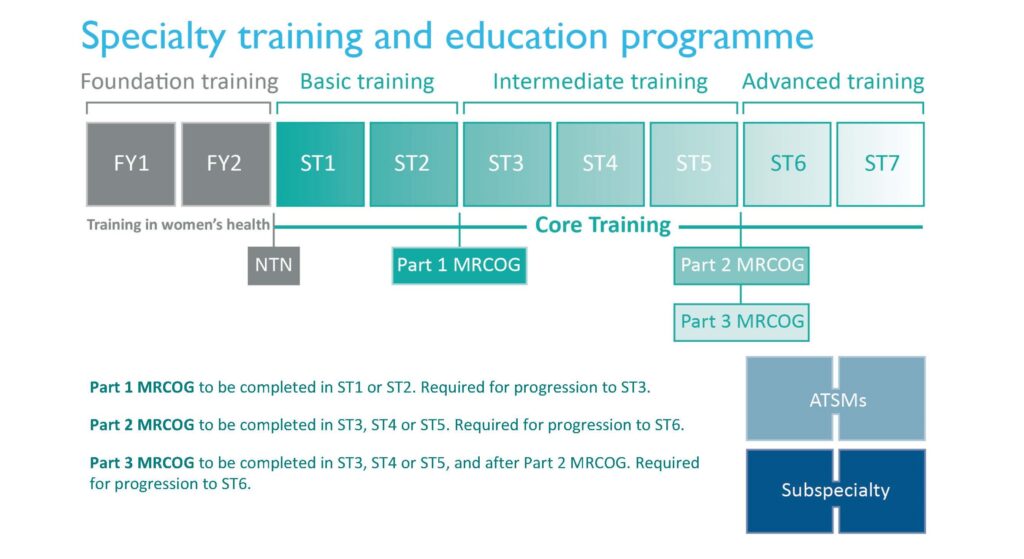
Foundation Training and Core Years
After completing your MBBS in India, you would typically start with Foundation Training in the UK (FY1-FY2). But as an international medical graduate, you can skip Foundation Training if you prove equivalent experience through the Certificate of Readiness to Enter Specialty Training (CREST) assessment.
Run-Through Gynaecology Training (ST1 to ST7)
Stage 1 — ST1 and ST2: Basic Training
General obstetrics and gynaecology. You manage antenatal clinics, labour ward, early pregnancy units, and routine gynaecology outpatients. On-calls begin from ST1. You must pass MRCOG Part 1 by the end of ST2 to progress to intermediate training.
Stage 2 — ST3 to ST5: Intermediate Training (Registrar Level)
You take on the O&G registrar role. You manage the labour ward independently overnight, perform Caesarean sections, deal with obstetric emergencies, and run gynaecology theatre lists. You must pass MRCOG Part 2 during this stage. By end of ST5, you must also pass MRCOG Part 3.
Stage 3 — ST6 and ST7: Advanced Training
You choose two Advanced Training Skills Modules (ATSMs) from subspecialty options:
- Maternal-Fetal Medicine
- Reproductive Medicine (IVF/ART)
- Urogynaecology
- Gynaecological Oncology
- Sexual and Reproductive Health
By end of ST7, you are working at near-consultant level.
Certificate of Completion of Training (CCT)
After completing ST7 and meeting all RCOG competency requirements, you receive CCT from the GMC. This places you on the GMC Specialist Register. You can then apply for NHS Consultant posts or return to India as a specialist — no NExT required.
What a Typical Week Looks Like
A realistic week as an O&G trainee: two days on the labour ward (12-hour shifts), one day in gynaecology theatre, one day in antenatal or gynaecology outpatient clinic, one day of protected teaching, audit, or portfolio time. You will also do night shifts and weekend on-calls — typically one in four to six weekends. The clinical exposure covers cases that many Indian PG residents only read about in textbooks.
NHS Salary During Training (2026 Rates)
| Grade | Annual Salary | Approximate Rs |
|---|---|---|
| ST1–ST2 | £54,499 | Rs 57 lakh |
| ST3–ST7 | up to £76,582 + on-call supplements | Rs 80 lakh+ |
| Consultant | £113,565–£150,569 | Rs 1.2–1.6 crore |
How to Pursue Gynaecology in the UK Without PLAB — All Routes Explained?
Most Indian doctors assume PLAB is the only door into the UK medical system. It is not — and for gynaecology specifically, the MRCOG non-PLAB routes are better suited to your goals.
Route 1 — MRCOG Exam Route (Available to Fresh MBBS Graduates and FMGs)
This is the most direct and most widely used route. It is open to:
- Fresh Indian MBBS graduates who have completed internship
- Foreign Medical Graduates (MBBS from Russia, China, Ukraine, Philippines, etc.)
- Doctors who have previously appeared for but not cleared PLAB
How it works:
MRCOG Part 1 can be taken from India — no travel to the UK required. Clearing MRCOG Part 1 demonstrates specialty-specific clinical competence to the GMC, supporting your registration application without needing PLAB.
Key facts:
- No prior OBG experience required for Part 1
- No NEET PG required
- No PLAB required
- Available to both IMG and FMG
- Part 1 exam centres in India: Delhi, Mumbai, Hyderabad (Pearson VUE)
- MRCOG Part 3 now also available in India — Kolkata and Mumbai from November 2026 onwards (previously London only)
Typical journey: Start Part 1 preparation during or just after internship → sit Part 1 in India → apply for GMC registration → apply for NHS Trust Grade or Clinical Fellow post in O&G → build UK portfolio → apply for ST1 national recruitment.
Route 2 — Sponsored GMC Registration Without PLAB
<!– Replaces MTI section entirely –>
Fresh MBBS graduates and doctors with existing PG qualifications in OBG may be eligible for sponsored GMC registration — where a UK university or NHS trust sponsors your GMC registration without requiring PLAB or UKMLA.
Career Voyage, as an authorised agent for the University of Chester and University of Dundee, works with university pathways that allow eligible candidates — including fresh MBBS graduates — to access sponsored registration routes through structured programme entry.
What sponsored registration gives you:
- GMC registration without PLAB
- Structured clinical exposure in UK O&G settings
- MRCOG preparation in a real NHS environment
- A strong foundation for ST1 national recruitment
Who is this for:
- Fresh MBBS graduates who want structured UK entry without sitting PLAB
- Indian MD/DNB OBG holders looking for a faster NHS entry route
- FMGs who want GMC registration without the UKMLA licensing route
Contact Career Voyage to assess whether your profile qualifies. Eligibility depends on your specific qualifications, clinical experience, and the university programme intake.
Route 3 — Portfolio Pathway (Formerly CESR) — For Senior Doctors
Previously known as CESR (Certificate of Eligibility for Specialist Registration), now officially called the Portfolio Pathway by the RCOG.
This route allows you to join the GMC Specialist Register without completing the full ST1–ST7 programme in the UK. You compile a portfolio demonstrating that your combined Indian and UK training is equivalent to CCT standard. The RCOG’s Portfolio Pathway Advisory Group assesses applications on behalf of the GMC.
Who this is for: Senior Indian OBG consultants with 8+ years of post-qualification experience who have also completed some UK training or fellowship.
Portfolio Pathway — Combined Programme: Doctors with substantial prior O&G experience can enter UK specialty training at ST3 or above, complete the remaining UK stage, and exit with a full CCT. This significantly compresses the timeline to Consultant level.
Short answer: If your goal is gynaecology specifically, MRCOG is the stronger choice.
PLAB is a general licensing exam — it gets you GMC registration but then you must compete for O&G training posts separately, at a lower starting grade. MRCOG is a specialty-specific qualification that demonstrates O&G competence directly, commands preference in ST applications, and leads to CCT faster. PLAB also requires travel to the UK for Part 2. MRCOG Parts 1 and 2 can be taken in India.
Choose MRCOG if you are committed to gynaecology. Choose PLAB only if you want to explore different specialties after arriving in the UK.
Route 4 — MSc Programme Route — The Bridge Into UK Gynaecology Training
An MSc from a UK university is not a clinical training route on its own — but it is one of the most practical ways for a fresh MBBS graduate to build a UK foundation before committing to the full MRCOG pathway.
What an MSc gives you that you cannot get from exam preparation alone:
- UK clinical exposure — you are in the UK, interacting with NHS systems, attending clinical sessions, understanding how O&G is practised in a British hospital environment
- Understanding NHS culture — communication standards, documentation, consent processes, MDT working — all of which are tested in MRCOG Part 3
- A competitive CV — UK university degree + research project + UK references puts you significantly ahead in ST1 applications compared to candidates who applied directly from India
- Time to start MRCOG Part 1 — you can sit MRCOG Part 1 while enrolled in an MSc in the UK
- Path to sponsored registration — MSc completion through a Career Voyage partner university can open the door to sponsored GMC registration discussions
MSc programmes relevant to gynaecology:
| Programme | University | Notes |
|---|---|---|
| MSc Clinical Embryology | University of Dundee | Career Voyage authorised agent. Popular for IVF/ART pathway. MBBS direct entry. |
| MSc Clinical Embryology | University of Oxford, University of Leeds | Competitive entry |
| MSc Women’s and Reproductive Health | UCL | Academic research focus |
| MSc Fetal Medicine | UCL | Subspecialty focused |
| MSc Reproductive and Sexual Health Research | LSHTM | Research pathway |
→ MSc Clinical Embryology in the UK — full guide → Gynaecology courses without PG in OBGYN — ART and fertility medicine options
Important: MSc programmes are academic degrees. They do not independently lead to GMC Specialist Registration or CCT. Their value is in building your pathway — not replacing it.
MRCOG Exam Guide for Indian Doctors — Parts 1, 2 and 3 Without PLAB
The MRCOG qualification is made up of three parts. All three must be passed to be awarded MRCOG membership. Unlike NEET PG, there is no single exam day that determines your career — you sit each part at different stages of training, and you can retake.
MRCOG Part 1 — Basic Sciences
What it tests: Applied basic sciences relevant to O&G — anatomy, physiology, pharmacology, pathology, embryology, genetics, microbiology, epidemiology, and statistics.
Format: Computer-based test (CBT) — two Single Best Answer (SBA) papers, 3 hours total.
When to sit: During ST1–ST2. Can be taken before entering UK training — many Indian doctors sit Part 1 while still in India or during an MSc programme.
Exam centres in India: Delhi, Mumbai, Hyderabad (Pearson VUE centres). Twice a year — January and June sessions.
Fee: Approximately £485 per attempt. From January 2025, GST applies to Part 1 and Part 2 fees for exams taken in India — factor this into your cost estimate.
Pass rate: Approximately 50–55% globally per session.
Preparation: RCOG’s StratOG e-learning platform, SBA question banks (MRCOG Prep, PassMedicine), RCOG Part 1 Revision Course (virtual option available). Allow 3–6 months of dedicated preparation.
MRCOG Part 2 — Clinical Knowledge and Application
What it tests: Clinical management of O&G conditions — diagnosis, investigation, management, therapeutics, clinical governance, and patient safety.
Format: Computer-based test (CBT) — SBA and Extended Matching Questions (EMQ) papers, 3 hours total.
When to sit: During ST3–ST5, after passing Part 1. Minimum 2 years of O&G clinical experience recommended before attempting Part 2.
Exam centres in India: Same Pearson VUE centres as Part 1 (Delhi, Mumbai, Hyderabad).
Fee: Approximately £710 per attempt. GST applies as with Part 1.
Pass rate: Approximately 45–50% globally per session.
Preparation: Clinical case-based learning, EMQ practice, RCOG Green-top Guidelines, RCOG Part 2 Revision Course.
MRCOG Part 3 — Clinical Skills OSCE
What it tests: Clinical skills, communication, patient safety, professional behaviour, and clinical decision-making in structured OSCE stations.
Format: 14-station OSCE (Objective Structured Clinical Examination). Each station tests a different clinical scenario — history taking, counselling, practical skills, emergency management.
When to sit: During ST5–ST7, after passing Part 2. Assessment of Training (AoT) from RCOG must be completed before applying for Part 3.
Fee: Approximately £1,590 per attempt.
Pass rate: Approximately 65–70% globally per session.
Exam venues — UPDATED 2026: Part 3 is now available at multiple international venues. From November 2026, Indian doctors can sit Part 3 in Kolkata and Mumbai — in addition to London. This removes the requirement to travel to the UK solely for the Part 3 exam. Cairo, Abu Dhabi, Malaysia, and Hong Kong are also available as international venues.
This is one of the most important recent updates for Indian candidates — you can now complete your entire MRCOG journey without leaving India.
What Indian doctors must prepare specifically for Part 3: MRCOG Part 3 tests UK clinical communication standards — structured consultations, breaking bad news, consent processes, and MDT communication. This is very different from Indian clinical practice. Candidates who fail Part 3 often have strong clinical knowledge but struggle with communication structure. Begin communication skills preparation early — ideally during your MSc or Trust Grade period in the UK, or through structured mock OSCE courses.
MRCOG Exam Cost Summary for Indian Doctors
| Fee (approx) | In Rs (approx) | |
|---|---|---|
| Part 1 | £485 + GST | Rs 52,000–55,000 |
| Part 2 | £710 + GST | Rs 75,000–80,000 |
| Part 3 | £1,590 | Rs 1,68,000 |
| IELTS / OET | £200–£250 | Rs 21,000–26,000 |
| GMC registration | £425 | Rs 45,000 |
| Total | ~£3,400–3,500 | ~Rs 3.6–4 lakh |
Significantly lower than Rs 1–2 crore for MD OBG at a private Indian medical college. Travel costs for Part 3 can now be eliminated by sitting in Kolkata or Mumbai.
Note on EOI and eligibility process: Before booking any MRCOG part, you must submit an Expression of Interest (EOI) form to the RCOG. New candidates must also complete an eligibility form. Contact Career Voyage for guidance on completing these forms correctly — errors in the eligibility process delay your exam booking.
Gynaecology Fellowships and Subspecialty Options in the UK for Indian Doctors
During ST6–ST7, you choose two Advanced Training Skills Modules (ATSMs). The main gynaecology fellowships and subspecialty areas in the UK for Indian doctors are:
- Maternal-Fetal Medicine — high-risk pregnancy, fetal diagnosis, prenatal screening
- Reproductive Medicine — infertility, IVF, assisted reproduction
- Urogynaecology — pelvic floor disorders, incontinence, prolapse surgery
- Gynaecological Oncology — cervical, ovarian, and endometrial cancers
- Sexual and Reproductive Health — contraception, menopause, sexual health clinics
- Early Pregnancy and Acute Gynaecology — ectopic pregnancy, miscarriage management
After CCT, you can further subspecialise through a 2–3 year post-CCT fellowship. Indian doctors who complete a post-CCT fellowship are particularly well-positioned for senior consultant and academic roles on return to India.
MRCOG vs MD OBG — A Side-by-Side Comparison for Indian Doctors
This is one of the most common questions Career Voyage receives. The right answer depends on your circumstances — but here is the honest comparison:
| Factor | MRCOG (UK) | MD OBG (India) |
|---|---|---|
| Entry method | No entrance exam after GMC registration | NEET PG — single high-stakes exam |
| Duration | 7 years (ST1–ST7) | 3 years |
| Can be started from India? | Yes — Part 1 and Part 2 in India | Yes — via NEET PG |
| Cost | Rs 3.6–4 lakh (exam + GMC fees) | Rs 5–50 lakh govt / Rs 1–2 crore private |
| Salary during training | Rs 57–80 lakh/year (NHS) | Rs 6–10 lakh/year (stipend) |
| Global recognition | UK, Gulf, Australia, NZ, Singapore, India | Primarily India |
| NExT/FMGE for India practice | Not required | Not required |
| Teaching eligibility in India | Yes — 2017 MCI Gazette (MD OBG equivalent) | Yes — direct |
| Subspecialty access | ATSMs in ST6–ST7 + post-CCT fellowships | DM/MCh after MD (another competitive exam) |
| Available to FMGs? | Yes — MRCOG has no MBBS country restriction | NEET PG only for Indian MBBS; FMGs need FMGE first |
Financial reality over 3 training years:
An MD OBG private student pays Rs 1–2 crore and earns a Rs 50,000–80,000/month stipend. An ST1 trainee in the UK pays nothing in fees and earns Rs 57 lakh/year. The net difference over 3 years: approximately Rs 2.5–3 crore in favour of the UK route.
Both qualifications are valid. MRCOG offers more international career mobility and is the only route that simultaneously resolves the FMGE/NExT problem for FMGs.
Step-by-Step Guide to Gynaecology in the UK After MBBS India — Without PLAB
Two tracks — choose the one that matches your situation.
Track A — Indian MBBS Graduate (IMG)
Step 1 — Complete MBBS and 1-year internship. Obtain permanent NMC India registration.
Step 2 — Begin IELTS Academic or OET preparation. Target: IELTS 7.5 overall (7.0 in each band) or OET Grade B in all modules. Allow 2–3 months.
Step 3 — Start MRCOG Part 1 preparation. Can run parallel to IELTS. Allow 3–6 months dedicated preparation.
Step 4 — Sit MRCOG Part 1 at a Pearson VUE centre in India (Delhi, Mumbai, or Hyderabad).
Step 5 — Apply for GMC registration using MRCOG Part 1 as specialty competence evidence (sponsored route) or explore university-sponsored GMC registration through Career Voyage’s partner universities.
Step 6 — Apply for NHS Trust Grade or Clinical Fellow posts in O&G. Alternatively, begin an MSc in the UK to build clinical exposure and CV alongside Part 1 preparation.
Step 7 — Build your UK portfolio — logbook entries, audit, QI project, teaching evidence, research. This is essential for ST1 applications.
Step 8 — Apply for ST1 national recruitment. Progress through ST1–ST7. Pass MRCOG Parts 2 and 3 during training.
Step 9 — Receive CCT at end of ST7. Apply for Consultant posts or return to India — no NExT required.
Whether you cleared NEET PG 2026 or not, this route remains open to you.
Track B — Foreign Medical Graduate (FMG) — MBBS from Abroad
If you completed MBBS from Russia, China, Ukraine, Philippines, or any country outside India and have not cleared FMGE/NExT — the UK gynaecology route is specifically relevant to you.
Step 1 — Complete your MBBS and internship. Ensure your degree is listed in the World Directory of Medical Schools (WDOMS).
Step 2 — Begin IELTS or OET preparation. Same targets as IMG track.
Step 3 — Start MRCOG Part 1 preparation. MRCOG has no restriction based on your MBBS country — it is open to all medical graduates globally.
Step 4 — Sit MRCOG Part 1 in India.
Step 5 — Apply for GMC registration. MRCOG Part 1 supports your GMC application. Alternatively, explore sponsored GMC registration through Career Voyage.
Step 6 — Enter NHS O&G — Trust Grade, Clinical Fellow, or MSc programme.
Step 7 — Progress through ST training, complete MRCOG Parts 2 and 3.
Step 8 — Receive MRCOG + CCT. Return to India if desired — MRCOG + GMC registration creates the legal basis for FMGE/NExT exemption consideration under the 2011 MCI Screening Test Amendment Regulations. <!– INTERNAL LINK –>
→ Full FMG recognition framework — Is UK Medical PG Recognised in India?
Gynaecology in the UK: Career Prospects and Salary After
According to NHS Health Careers (updated April 2026) and current NHS job listings:
| Grade | NHS Salary (£) | Approximate Rs |
|---|---|---|
| ST1–ST2 | £54,499 | Rs 57 lakh |
| ST3–ST7 | £54,499–£76,582 + on-call supplements | Rs 57–80 lakh+ |
| Consultant O&G | £113,565–£150,569 | Rs 1.2–1.6 crore |
| Locum Consultant O&G | £109,725–£145,478 | Rs 1.15–1.53 crore |
Senior O&G consultants in London combining NHS and private practice can earn over £200,000 per year — approximately Rs 2.1 crore.
The Indeed UK salary database (April 2026) reports the average O&G physician salary in England at £115,861 per year.
If you return to India after MRCOG:
- Apply directly for Assistant Professor posts in NMC-recognised medical colleges — 2017 MCI Gazette confirms MRCOG is MD OBG equivalent for teaching appointments
- Private hospital consultant positions — MRCOG + UK training background commands premium positioning
- No NExT examination required
- Direct State Medical Council registration with MRCOG certificate (apostille) + GMC registration letter
Gynaecology in the UK – Frequently Asked Questions
Can I pursue gynaecology in the UK without PLAB after MBBS India?
Yes. The MRCOG exam route, sponsored GMC registration, and Portfolio Pathway all bypass PLAB. MRCOG Part 1 can be taken in India at Pearson VUE centres in Delhi, Mumbai, or Hyderabad.
Can I prepare for MRCOG while still in India?
Yes. MRCOG Parts 1 and 2 are available at Pearson VUE centres in India. From November 2026, Part 3 is also available in Kolkata and Mumbai. Many candidates begin Part 1 preparation during their internship year or final MBBS year. You can complete your entire MRCOG journey without leaving India.
I have MBBS from Russia/China/Ukraine and haven’t cleared FMGE. Can I do MRCOG?
Yes. MRCOG has no restriction based on your MBBS country. It is open to all medical graduates globally. When you complete MRCOG and obtain GMC registration, you are recognised for enrolment as a medical practitioner in the UK — which creates the legal basis for FMGE/NExT exemption consideration in India under the 2011 MCI Screening Test Amendment Regulations. Contact Career Voyage to understand your specific position.
Will MRCOG be accepted in India to practise without NExT?
Yes. The UK is one of five countries (USA, UK, Canada, Australia, New Zealand) where completing PG exempts you from NExT and FMGE. MRCOG is covered under Part II, Third Schedule of the IMC Act. Full details on our NMC recognition page.
Is MRCOG equivalent to MD OBG for teaching in Indian medical colleges?
Yes. The 2017 MCI Gazette Notification (No. MCI-12(1)/2016-Med.Misc./175608) confirms UK PG qualifications including MRCOG are considered equivalent to MD for Assistant Professor appointments in Indian medical colleges.
Is MRCOG better than PLAB for gynaecology?
For gynaecology specifically, MRCOG is the better route. PLAB is a general licence exam — it gets you GMC registration but you then compete for O&G posts at a lower entry grade. MRCOG demonstrates specialty-specific competence, commands preference in ST applications, and does not require travel to the UK for Parts 1 and 2.
Do I need an Indian MD OBG before doing MRCOG?
No. MRCOG can be done directly after MBBS and internship. No Indian PG is required.
What is sponsored GMC registration for gynaecology?
Sponsored GMC registration is a route where a UK university or NHS trust sponsors your GMC registration without requiring PLAB or UKMLA. Career Voyage, as an authorised agent for the University of Chester and University of Dundee, can assess whether your profile qualifies for sponsored registration through university pathways. Available to fresh MBBS graduates and doctors with existing OBG qualifications.
What is the Portfolio Pathway (formerly CESR)?
A route to join the GMC Specialist Register by demonstrating your combined Indian and UK training is equivalent to CCT standard — without completing the full ST1–ST7 programme. Suitable for senior OBG consultants with 8+ years experience who have also completed some UK training.
What does MRCOG cost for Indian doctors in 2026?
Total cost — Parts 1, 2, and 3 plus IELTS and GMC registration — approximately Rs 3.6–4 lakh. From January 2025, GST applies to Part 1 and Part 2 fees for exams taken in India. Part 3 can now be taken in Kolkata or Mumbai, reducing travel costs significantly.
What is the salary of a gynaecologist in the UK in 2026?
ST1–ST2: £54,499/year (Rs 57 lakh). ST3–ST7: up to £76,582 + supplements (Rs 80 lakh+). Consultant: £113,565–£150,569 (Rs 1.2–1.6 crore). Senior consultants with private practice in London can earn over £200,000/year (Rs 2.1 crore+).
How Career Voyage Helps You Pursue Gynaecology in the UK Without PLAB
Career Voyage is an authorised agent for the many UK Top Ranked Public Universities. Our core expertise is the Non-PLAB route — it is what we specifically focus on, not a side offering.
We help with:
- Profile assessment — which route fits you: MRCOG exam route, sponsored GMC registration, Portfolio Pathway, or MSc
- MRCOG exam preparation guidance — EOI process, study plan, resources
- Sponsored GMC registration — eligibility assessment and university programme application
- MSc programme applications — University of Chester, University of Dundee, and other partner universities
- NHS job application coaching — CV, personal statement, portfolio building guidance
- NMC India registration — additional qualification registration on return
Free first consultation — no charge for profile assessment. Call or WhatsApp: +91 96503 47138 / +91 75007 94444
Topics of Interest
Is UK Medical PG Recognised in India? — Full legal explanation, gazette citations, IMG and FMG guidance
Clinical Embryology course in the UK
Gynaecology Superspeciality courses without PG in OBGYN