Introduction: Your Pathway to a Global Radiology Career
Radiology in the UK refers to the structured five-year specialty training programme in clinical radiology, regulated by the Royal College of Radiologists (RCR) and leading to the Fellowship of the Royal College of Radiologists (FRCR). Indian MBBS graduates who complete this training and gain entry to the GMC Specialist Register can practise as specialist radiologists in India without clearing FMGE or NExT, because the UK is one of only five countries whose postgraduate medical degrees are directly recognised by India’s National Medical Commission (NMC).
If you are an Indian MBBS graduate considering a career in radiology abroad, the United Kingdom offers one of the most structured and globally respected training pathways available. UK radiology qualifications — particularly the FRCR — are recognised by India’s National Medical Commission (NMC), meaning you can return to practise in India without clearing FMGE or NExT.
This guide covers everything you need to know: training structure, entry requirements, the three IMG pathways (CCT, CESR-CP, CESR), FRCR exam breakdown and fees, realistic salary expectations, cost of living, visa options, and a step-by-step application plan. Whether you are just finishing your MBBS or you have already completed radiology training in India, there is a route for you. Career Voyage has helped hundreds of Indian doctors understand and access these UK pathways — and this article reflects that experience.
If you want to know whether you are eligible for radiology training in the UK, get in touch with Career Voyage. Our team will review your profile and tell you exactly which pathway and programmes you can apply for. Call us or send a WhatsApp message for a free consultation.
Why Pursue Radiology in the UK?
The UK remains one of the top destinations for Indian doctors pursuing radiology abroad, and there are several practical reasons behind this — not just prestige.
NMC Recognition Without Extra Exams
The National Medical Commission (NMC) of India recognises UK postgraduate medical degrees. If you complete radiology specialty training in the UK and obtain your CCT or CESR, you can register as a specialist in India without sitting for FMGE or NExT. This is a significant advantage that very few countries offer — only the UK, USA, Canada, Australia, and New Zealand are on this list.
Advanced Facilities and Clinical Volume
The NHS handles over 47 million diagnostic imaging examinations every year across its hospitals. As a trainee, you will work with the latest CT, MRI, PET-CT, and interventional radiology equipment in hospitals like the Royal Brompton Hospital (cardiac imaging), the National Hospital for Neurology and Neurosurgery (neuroradiology), and large teaching hospitals across London, Manchester, Edinburgh, and Leeds.
Structured 5-Year Training with Clear Milestones
Unlike many countries where radiology training can be fragmented, the UK offers a single run-through programme from ST1 to ST5, regulated by the Royal College of Radiologists (RCR). You know exactly what is expected at each stage, what exams you need to pass, and when you will finish.
Severe Shortage of Radiologists — Your Opportunity
According to the Royal College of Radiologists’ 2024 Workforce Census, the UK currently has a 29% shortfall of consultant clinical radiologists — a gap projected to rise to 39% by 2029 if nothing changes. The UK needs 1,953 more consultant radiologists just to meet current patient demand. There are only 10.1 radiologists per 100,000 population in the UK, compared to a European average of about 12. Clinical radiology remains on the UK’s Shortage Occupation List, which means easier visa processing and no cap on Skilled Worker visas for radiologists.
What this means for Indian doctors: 38% of clinical radiology consultants in the UK gained their primary medical qualification outside the UK. The NHS actively needs international radiologists. This is not a token gesture — it is a structural workforce dependency.
Competitive NHS Salary
Consultant radiologists in the NHS earn between £109,000 and £145,000 per year (approximately ₹1.12 crore to ₹1.49 crore). Even during training, specialty registrars earn £52,000 to £74,000 depending on their ST level. Total earnings are typically 15–30% higher when you include on-call supplements, weekend allowances, and additional programmed activities.
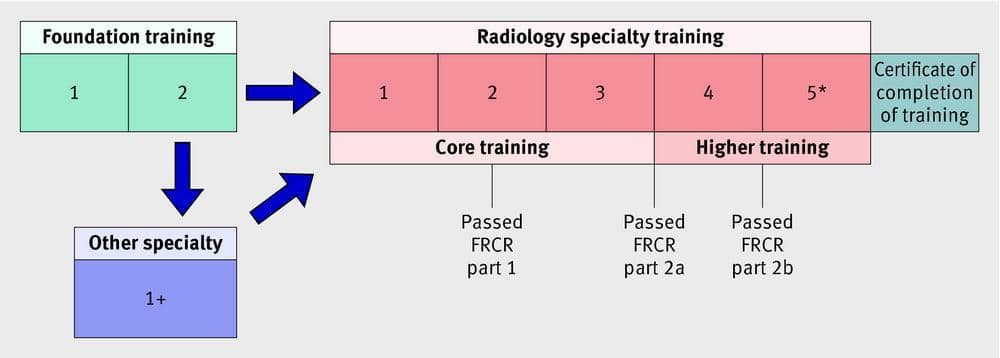
Radiology in the UK: Step-by-Step Training Structure
Radiology training in the UK is a run-through programme lasting 5 years (ST1–ST5), with an optional 6th year (ST6) for subspecialisation in interventional radiology. The programme is divided into two main phases:
Phase 1: General Radiology Training (ST1–ST3) — 3 Years
During the first three years, you build a strong foundation across all core imaging modalities:
- Plain radiography (X-rays), ultrasound, CT, and MRI interpretation
- Emergency and on-call radiology reporting
- Image-guided procedures (basic interventional skills)
- Workplace-based assessments (WBAs) and clinical rotations across departments
You must pass the First FRCR Exam (physics and anatomy) during this phase to progress. Specifically, you need to pass FRCR Part 1 by the end of ST1 to move to ST2.
Phase 2: Special Interest Training (ST4–ST5) — 2 Years
In the final two years, you choose a subspecialty focus and develop advanced diagnostic and procedural skills. Available subspecialties include:
- Neuroradiology
- Musculoskeletal radiology
- Cardiac radiology
- Paediatric radiology
- Vascular and interventional radiology
- Gastrointestinal radiology
- Oncological imaging
- Head and neck radiology
- Breast radiology
You must pass the Final FRCR Exam (Parts 2A and 2B) during this phase. You need to pass Part 2A to progress into ST4, and you can only attempt Part 2B after completing 34 months in a formal clinical radiology training post. Completion leads to the Certificate of Completion of Training (CCT) and eligibility for the GMC Specialist Register.
Optional: ST6 — Interventional Radiology (1 Year)
For those interested in interventional radiology, an additional year of subspecialty training is available after completing ST5. Interventional radiology is the only formally recognised subspecialty within UK radiology, and it was granted GMC subspecialty recognition in recent years. Since 2022, trainees can also declare a preference for interventional radiology from ST1 entry and receive dedicated IR exposure from the start of training.
The RCR’s 2024 census found that 56% of clinical directors said they did not have sufficient interventional radiologists to deliver safe patient care. This shortage makes IR a particularly strong career choice for IMGs.
The Educational Journey: From MBBS to UK Radiology Consultant
Here is how the complete pathway looks for an Indian MBBS graduate:
| Stage | Duration | Details |
|---|---|---|
| MBBS (India) | 5.5 years | Complete your medical degree from an NMC-recognised institution |
| Internship | 1 year | Mandatory rotating internship in India |
| GMC Registration | 3–6 months | Pass PLAB 1 + PLAB 2 (now UKMLA-aligned) + IELTS/OET, or get sponsorship via a GMC-approved employer, or pass FRCR to bypass PLAB entirely |
| Foundation-equivalent / NHS experience | 1–2 years | Many IMGs work as clinical fellows or trust-grade doctors to build UK clinical experience before applying for ST1 |
| Radiology Specialty Training (ST1–ST5) | 5 years | Run-through programme with FRCR exams |
| CCT and Specialist Registration | — | Enter the GMC Specialist Register as a Consultant Radiologist |
GMC Registration: Understanding the PLAB to UKMLA Transition
This is one of the most confusing areas for Indian doctors in 2025-2026, so here is a clear explanation.
The General Medical Council (GMC) has introduced the UK Medical Licensing Assessment (UKMLA) as a national licensing standard. For international medical graduates, here is what this means practically:
You still take PLAB 1 and PLAB 2. The GMC has confirmed that “international doctors will continue to take PLAB, which is now MLA compliant.” The PLAB exams have been aligned with the UKMLA content map, but the format remains essentially the same — PLAB 1 is a 180-question SBA written exam, and PLAB 2 is an 18-station OSCE held in Manchester.
The key facts for Indian doctors applying for radiology training:
- PLAB 1 is equivalent to the UKMLA Applied Knowledge Test (AKT)
- PLAB 2 is equivalent to the UKMLA Clinical and Professional Skills Assessment (CPSA)
- The term “PLAB” may eventually be replaced by “UKMLA,” but for now both terms refer to the same IMG assessment route
- If you have passed PLAB 1, you do not need to retake the AKT — your result carries over
- If you pass the FRCR exam, you can bypass PLAB/UKMLA entirely and obtain GMC registration through the Postgraduate Qualification (PGQ) route
This last point is particularly relevant for Indian doctors who have already completed MD or DNB Radiology in India. If you pass all three parts of the FRCR, you can apply for GMC registration without ever taking PLAB.
Three Pathways for International Medical Graduates (IMGs)
Indian doctors have three recognised routes into UK radiology, each suited to different career stages. All three lead to qualifications recognised by India’s NMC.
1. CCT Route — Traditional Specialty Training
This is the standard pathway. You apply for ST1 through the national Oriel recruitment system, complete the full 5-year programme, and receive a CCT at the end.
Best for: Indian doctors who have completed MBBS + internship and have less than 18 months of post-internship radiology experience.
Key facts:
- Entry at ST1 level only through national recruitment (ST3 entry also exists as a separate competitive process — see below)
- Highly competitive — 100% fill rate in recent years, roughly 4 applicants per post
- Requires GMC registration with a licence to practise
- Selection includes the MSRA (Multi-Specialty Recruitment Assessment) which contributes to shortlisting, plus a portfolio-based interview
- The MSRA score contributes 33% of the final selection centre score for ST1 radiology posts
Important note: If you have more than 18 months of post-internship radiology experience, you may be considered overqualified for ST1 entry and should consider the CESR-CP or CESR routes below.
ST3 Entry — A Separate Competitive Route
The RCR also runs a separate ST3 recruitment process for doctors who already have radiology experience, either from the UK or internationally. If you enter at ST3, you complete 3 years of training instead of 5, but you must have passed FRCR Part 1 and obtained an “Alternative Certificate to Enter Clinical Radiology Specialty Training” signed by a consultant radiologist who has worked with you for at least 3 continuous months. This route is particularly relevant for Indian doctors with MD or DNB Radiology who want a faster path to CCT.
2. CESR-CP Route — Combined Programme for Experienced IMGs
This route is for doctors who already have some radiology training and want to enter at ST2 or ST3 level.
Best for: Indian doctors with 1–3 years of radiology residency (MD/DNB) who want to complete the remaining training in the UK.
Key facts:
- Requires a minimum of 4 years of clinical radiology training (UK + overseas combined) to be awarded a CCT
- No national-level application process — you apply directly to hospitals advertising non-training posts (specialty doctor, clinical fellow, registrar)
- You must find a department that actively supports CESR-CP portfolios
- Less standardised than the CCT route
3. CESR Route — Direct Consultant Recognition
This is for fully trained radiologists who want to skip training entirely and be recognised as consultants.
Best for: Indian radiologists who have completed MD/DNB Radiology + several years of independent specialist practice.
Key facts:
- Requires documentary evidence that your training and experience are equivalent to UK CCT standards
- Evidence can come from the UK, overseas, or a combination of both
- You apply to the GMC with a portfolio assessed against the RCR curriculum
- Once approved, you are placed directly on the GMC Specialist Register
- You can then apply for consultant or locum consultant posts in the NHS
Note on equivalence: Within the UK, CCT, CESR-CP, and CESR are all treated as equivalent — you will be recognised as a Consultant Radiologist through any of these routes. However, if you plan to later move to a third country, check whether that country accepts CESR, as some do not.
What If You Don’t Get Into ST1 or ST3?
This is the reality most Indian doctors need to plan for. UK radiology ST1 is extremely competitive, and many excellent candidates do not get a training number on their first attempt. Here is the realistic alternative pathway that many successful UK radiologists have followed:
- Secure a clinical fellow, specialty doctor, or trust-grade registrar post in a radiology department
- Begin passing your FRCR exams while working — Part 1 and Part 2A can be sat from India or internationally
- Build your radiology portfolio: audit projects, teaching, MDT participation, research
- Apply again for ST1 or ST3 in subsequent years, or build towards a CESR consultant application
- Find a department that supports CESR portfolios — this is crucial and varies widely between NHS trusts
Many radiologists in the UK have reached consultant level through this route rather than through formal national training. The key is finding a supportive department and being persistent. Career Voyage can help you identify trusts that are known for supporting IMG radiologists on the CESR pathway.
FRCR Examination: Complete Breakdown
The Fellowship of the Royal College of Radiologists (FRCR) is the mandatory examination for UK radiology training. It is divided into three parts:
First FRCR (Part 1)
| Component | Format | Details |
|---|---|---|
| Physics | 40 single best answer (SBA) questions | Tests understanding of imaging physics — X-ray production, radiation safety, MRI principles, CT physics, ultrasound physics |
| Anatomy | Image-based questions (20 images, 5 observations each) | Cross-sectional anatomy recognition on CT, MRI, and plain film |
Eligibility: You must be in (or have been in) a formal clinical radiology training post. No minimum duration is required.
Exam held: Typically March and September.
Exam locations: UK cities (London, Manchester, Leeds, Edinburgh, and others) and internationally including in India (Delhi, Mumbai, Chennai, Bangalore), Egypt, Hong Kong, Pakistan, and Singapore.
Important for Indian doctors: You can sit FRCR Part 1 while still working in India, provided you are in or have been in a radiology training post. This means you can begin your FRCR journey before moving to the UK.
Final FRCR Part 2A
| Detail | Info |
|---|---|
| Format | Two papers, 120 SBA questions each (3 hours per paper, same day) |
| Content | All subspecialties — chest, MSK, GI, GU, paediatrics, neuro, head and neck, cardiac |
| Eligibility | Must have passed Part 1 + completed 24 months of radiology training |
| Held | Twice a year — typically April and November |
Part 2A can also be sat internationally, including in India.
Final FRCR Part 2B
| Detail | Info |
|---|---|
| Format | Three components held over one week: rapid reporting, long cases, oral/viva examinations |
| Content | Image interpretation, clinical reasoning, communication skills |
| Eligibility | Must have passed Part 2A + completed 34 months of radiology training |
| Held | Twice a year — typically April and October |
Note: The RCR announced reforms to the Part 2B format from June 2025. The three-component structure (reporting, rapid reporting, oral) remains, but the standard-setting method and delivery platform have been updated. Always check the RCR website for the latest format details before your exam sitting.
Part 2B must be taken in the UK. This is the only part of the FRCR that requires you to be physically present in the UK.
FRCR Exam Fees
The total cost of all three FRCR exams is approximately £2,754 for non-RCR members and £2,078 for RCR members. An RCR membership provides access to exam prep materials, the Learning Hub, and a professional network but costs additional annual fees.
Note: UK trainees (RCR members) are given first priority for exam bookings. International candidates book after UK trainees have been accommodated. Apply early — spaces are limited, particularly for Part 2B.
Fees vary depending on whether you sit the exam in the UK or internationally. Visit the Royal College of Radiologists exam pages for the latest fee schedule.
How to Apply for UK Radiology Training — Step by Step
This numbered process applies to the CCT route (ST1 entry). Career Voyage recommends starting preparation 12–18 months before you plan to apply.
Step 1: Pass your English language test. You need IELTS Academic with overall 7.5 (minimum 7.0 in each band) or OET grade B in all components. Book this first — results take time and are required for GMC registration.
Step 2: Pass PLAB 1 and PLAB 2 (or obtain GMC registration through FRCR or sponsorship). PLAB 1 can be taken in India. PLAB 2 must be taken in Manchester, UK.
Step 3: Obtain full GMC registration with a licence to practise. You cannot apply for specialty training without this.
Step 4: Gain UK clinical experience. Work as a clinical fellow, trust-grade doctor, or in a similar NHS post for 1–2 years. This is not a formal requirement, but almost all successful IMG applicants have UK experience.
Step 5: Prepare for the MSRA. The Multi-Specialty Recruitment Assessment is used in shortlisting for ST1 radiology. It tests clinical problem-solving and professional dilemmas. Your MSRA score contributes 33% of your final selection score.
Step 6: Submit your application through Oriel. Applications typically open in November each year for an August start. You will need your GMC registration, IELTS/OET scores, internship proof, CREST form, and references ready.
Step 7: Attend interview and selection centre. If shortlisted, you will be interviewed (usually March). Offers are made based on combined MSRA + interview scores.
Step 8: Accept your training post and begin ST1 in August.
Radiology in the UK: Entry Requirements for Indian Graduates
To begin radiology training in the UK, you will need:
- MBBS degree from an NMC-recognised institution in India
- GMC Registration with a licence to practise — obtained by passing PLAB 1 + PLAB 2 (now aligned with the UKMLA content map), or through sponsorship by a GMC-approved employer, or by passing the FRCR exam (Postgraduate Qualification route)
- English language proficiency — IELTS Academic (overall 7.5, minimum 7.0 in each band) or OET (grade B in all components)
- NHS clinical experience — while not a formal requirement, most successful IMG applicants have 1–2 years of UK clinical experience before applying for ST1
- Application through Oriel — the national recruitment portal for UK specialty training. Applications typically open in November for an August start the following year.
Radiology in the UK: Cost of Studying and Living in the UK
Here is a realistic cost breakdown for Indian doctors entering radiology training: [ORIGINAL]
| Expense | Estimated Cost |
|---|---|
| PLAB 1 exam | £262 |
| PLAB 2 exam | £972 |
| IELTS/OET | £200–£400 |
| GMC registration fee | £439 (annual) |
| FRCR exams (all parts) | £2,078–£2,754 |
| Skilled Worker Visa (Health and Care) | £284 (reduced rate for health workers) |
| Immigration Health Surcharge (IHS) | £624/year |
| Living costs — London | £1,300–£2,000/month |
| Living costs — outside London | £900–£1,400/month |
Important: Once you are in an NHS training post, you will be earning a salary from day one. ST1 basic salary starts at approximately £52,656 per year (2025-26 pay scale), so the cost of living is covered by your earnings.
Radiology in the UK – Salary Expectations: From Trainee to Consultant
| Grade | Basic Annual Salary (2025-26) | Approximate INR Equivalent |
|---|---|---|
| ST1 (Specialty Trainee Year 1) | £52,656 | ₹54 lakh |
| ST3 | £56,510 | ₹58 lakh |
| ST5 | £65,048 | ₹67 lakh |
| ST8 (top of training scale) | £73,992 | ₹76 lakh |
| Consultant (starting) | £109,000 | ₹1.12 crore |
| Consultant (experienced, 10+ years) | £145,000 | ₹1.49 crore |
These are basic salaries only. Total earnings are typically 15–30% higher when you include on-call supplements (37% enhancement for nights), weekend allowances, and additional programmed activities. Many consultants also supplement their NHS income with private practice, locum work, or medico-legal reporting.
For context: NHS England announced a 3.3% pay rise for NHS workers in 2026. Consultant salaries have been rising steadily, and the shortage-driven demand means negotiating leverage for new consultants is strong, particularly in regions with acute vacancies.
NMC Recognition: Practising in India After Radiology in the UK
The National Medical Commission (NMC) of India recognises UK postgraduate medical qualifications, including those obtained through radiology specialty training leading to CCT or CESR. This means:
- You can register as a specialist radiologist in India without sitting for FMGE or NExT
- Your FRCR qualification carries strong brand value with private hospital chains, diagnostic centres, and medical colleges in India
- Many returning radiologists secure senior consultant positions or establish their own imaging centres
The UK is one of only five countries — along with the USA, Canada, Australia, and New Zealand — whose postgraduate medical degrees are directly recognised by the NMC for specialist registration in India. This recognition applies as long as your training leads to specialist registration in the respective country (that is, your name must appear on the GMC Specialist Register).
For the official list of recognised qualifications, visit NMC India.
Radiology in the UK: Visa Options for Indian Doctors
| Visa Type | Duration | Key Details |
|---|---|---|
| Skilled Worker Visa (Health and Care) | Up to 5 years (renewable) | Most common for NHS training posts. Reduced application fee (£284). No Immigration Skills Charge for health workers. Leads to Indefinite Leave to Remain (ILR) after 5 years. |
| Tier 2 Shortage Occupation | Included in Skilled Worker | Clinical radiology is on the Shortage Occupation List, so no need for Resident Labour Market Test |
| Graduate Visa | 2 years (post-study) | For those completing a UK university degree — less relevant for specialty trainees |
| Tier 5 (MTI) | Training Duration | For Medical Training Initiative posts sponsored by the Royal College of Radiologists or an NHS trust |
Your NHS employer typically sponsors the Skilled Worker Visa as part of the appointment process. Since radiology is on the Shortage Occupation List, the visa process is faster and less restrictive than for non-shortage specialties. After 5 years on a Skilled Worker visa, you can apply for Indefinite Leave to Remain (ILR). After 1 year with ILR, you can apply for British citizenship.
NMC Recognised MD Radiology Abroad: How the UK Compares to Other Countries
| Factor | UK | USA | Australia |
|---|---|---|---|
| Training duration | 5 years (ST1–ST5) | 5 years (1 year internship + 4 years residency) | 5 years |
| Key exam | FRCR | USMLE + ABR | FRANZCR |
| Licensing exam for IMGs | PLAB / UKMLA | USMLE Steps 1, 2, 3 | AMC |
| NMC recognition in India | Yes | Yes | Yes |
| Shortage occupation | Yes — faster visa | No special pathway | Regional shortages |
| Language requirement | IELTS 7.5 / OET B | USMLE itself | IELTS 7.0 / OET B |
| Can sit specialty exam from India | Yes (FRCR Part 1 and 2A) | No (all in USA) | No |
The UK’s key advantage over the USA is that it does not require a general licensing exam across all medical subjects (like the USMLE). The FRCR is radiology-specific from the start, which many Indian doctors find more efficient. Additionally, the UK’s Shortage Occupation List designation makes immigration significantly simpler than in the USA or Australia. A practical advantage many Indian doctors overlook: FRCR Part 1 and Part 2A can be taken in Indian cities (Delhi, Mumbai, Chennai, Bangalore), so you can begin qualifying before you even leave India.
AI and the Future of Radiology in the UK
One question every Indian doctor asks: will AI replace radiologists? The short answer is no — and the RCR’s own data backs this up.
The RCR’s 2024 workforce census acknowledges that AI tools are being deployed in radiology departments across the NHS, but explicitly states that AI-based productivity gains “will not resolve [workforce shortages] altogether.” AI is currently being used as a triage tool (flagging urgent findings for faster human review) and for quality assurance, not as a replacement for radiologist reporting.
In fact, the increasing use of AI may create more demand for radiologists who can validate, interpret, and clinically contextualise AI outputs. The number of imaging examinations in the NHS continues to grow at 8% per year — far faster than the workforce is growing. For Indian doctors entering UK radiology now, the career outlook remains strong for decades to come.
Radiology in the UK: Clinical Exposure and Subspecialty Opportunities
During your 5-year training, you will rotate through multiple NHS hospitals and gain experience across all imaging modalities — plain film, CT, MRI, ultrasound, fluoroscopy, nuclear medicine, and PET-CT. The breadth of NHS case volume means you will encounter a wide range of pathology that many other healthcare systems simply cannot offer.
Trainees also participate in:
- Audit and quality improvement projects (mandatory for portfolio)
- Teaching and mentoring junior doctors
- Multidisciplinary team (MDT) meetings
- Research and academic publications
In the later years (ST4–ST5), you develop deeper expertise in your chosen subspecialty through extended rotations. Many trainees also undertake informal fellowships at specialist centres. Post-CCT, formal 1-year fellowship posts are available at major teaching hospitals in areas like neuroradiology, interventional radiology, breast radiology, and musculoskeletal imaging — these are competitive but excellent for further subspecialisation.
Radiology in the UK: Application Tips for Indian Doctors
Start early. UK radiology ST1 recruitment typically opens in November each year through the Oriel portal, with shortlisting in January-February and interviews in March for an August start. There are very limited posts and the competition ratio is high, so preparation needs to begin 12–18 months in advance.
Build UK clinical experience first. The strongest IMG applications for ST1 come from candidates who have already worked in the NHS for 1–2 years. Clinical fellow, trust-grade SHO, or specialty doctor posts in radiology or acute medicine departments give you exposure to the NHS culture, systems, and referees.
Prepare your MSRA early. The Multi-Specialty Recruitment Assessment (MSRA) is used in the shortlisting process. It tests clinical problem-solving and professional dilemmas. Dedicated MSRA prep courses are available and scoring well can make the difference between getting an interview or not.
Gather documentation meticulously. You will need proof of your internship completion, CREST form, IELTS/OET scores, GMC registration, and references. Missing documentation is one of the most common reasons for failed applications.
Consider sitting FRCR Part 1 from India before applying. If you can pass FRCR Part 1 while still in India, it significantly strengthens your application for both ST1 and ST3 posts, and demonstrates genuine commitment to radiology.
Stay updated on official sources:
- Royal College of Radiologists (RCR) — training curriculum, FRCR exam dates and fees
- NMC India — recognised qualifications list
- NHS Oriel — ST1 and ST3 application portal
- NHS Jobs — non-training posts, clinical fellowships, specialty doctor vacancies
Frequently Asked Questions
How competitive is radiology ST1 in the UK?
Very competitive. The fill rate has been 100% in recent years, with roughly 4 applicants for every available post. For IMGs, building UK clinical experience, scoring well on the MSRA, and having a strong portfolio are essential for a successful application.
Can I sit the FRCR exam without being in a UK training programme?
Yes. IMGs who are not in a UK radiology training scheme can sit FRCR Part 1 and Part 2A, provided they are in or have been in a formal clinical radiology training post anywhere in the world. Part 2B requires 34 months of radiology training. Exams are held internationally, including in Indian cities.
Can I sit the FRCR exam from India?
Yes. FRCR Part 1 and Part 2A are held in Indian cities including Delhi, Mumbai, Chennai, and Bangalore. Only Part 2B must be taken in the UK. You can begin your FRCR qualification while still working in India, provided you are in or have been in a formal radiology training post.
What subspecialties can I pursue during radiology training?
You can develop a special interest in neuroradiology, musculoskeletal, cardiac, paediatric, vascular/interventional, gastrointestinal, oncological, breast, or head and neck radiology. Only interventional radiology has a formal additional year (ST6) of training. Other subspecialties are pursued through fellowships and extended rotations.
How much does the FRCR exam cost in total?
Approximately £2,754 for non-RCR members, or £2,078 for members, across all three parts. Fees vary by exam location. Check the Royal College of Radiologists website for the most current fees.
Is the FRCR recognised in India?
Yes. The FRCR is recognised by the NMC for specialist registration (when combined with UK specialist registration) and by private hospitals, diagnostic chains, and medical colleges in India as a mark of advanced radiology training.
What visa do I need for UK radiology training?
Most Indian doctors use the Skilled Worker Visa (Health and Care Worker route). Since clinical radiology is on the Shortage Occupation List, you benefit from reduced visa fees (£284), no Immigration Skills Charge, and faster processing. Your NHS employer sponsors the visa.
Can I return to India after completing training?
Yes. Many Indian doctors complete FRCR and CCT, work as NHS consultants for a few years, then return to India where UK credentials command premium positions. FRCR-qualified radiologists in India typically earn ₹25–60 lakh or more per year in private practice or top hospital chains.
What are the alternatives if I don’t get into ST1 radiology?
You can work as a clinical fellow, specialty doctor, or trust-grade registrar in radiology while passing FRCR exams and building your portfolio. Many UK radiologists reached consultant level through the CESR route rather than formal training. Career Voyage can help identify supportive NHS trusts for this pathway.
How many radiologists does the UK need?
According to the RCR’s 2024 Workforce Census, the UK needs 1,953 more consultant clinical radiologists to meet current demand. The shortfall is 29%, projected to rise to 39% by 2029. There are 4,699 consultant radiologists in the UK, and 38% qualified outside the UK.
Will AI replace radiologists in the UK?
No. The RCR states AI tools “will not resolve workforce shortages altogether.” AI is used for triage and quality assurance, not replacing radiologist reporting. NHS imaging demand grows at 8% per year while the workforce grows under 5%, so the human radiologist shortage will persist for decades.
Has PLAB been replaced by UKMLA?
Not exactly. For IMGs, PLAB continues under the same name and format. The GMC confirms “international doctors will continue to take PLAB, which is now MLA compliant.” PLAB 1 aligns with UKMLA AKT, PLAB 2 with CPSA. If you have passed FRCR, you can bypass PLAB/UKMLA entirely.
How Career Voyage Can Help You With Radiology in the UK
At Career Voyage, our team includes seasoned medical professionals with firsthand experience in UK radiology training and NHS systems. We provide:
- Personalised pathway assessment based on your qualifications and experience
- Guidance on GMC registration, PLAB/UKMLA preparation, and FRCR strategy
- Application support for NHS training posts and clinical fellowships
- Documentation assistance, interview preparation, and visa guidance
- Identification of NHS trusts that support CESR portfolios for IMG radiologists
To check your eligibility and understand which UK pathway is right for you, contact Career Voyage. We have helped hundreds of Indian MBBS doctors and foreign medical graduates get into UK radiology training and consultant posts. Call us or WhatsApp for a free consultation.
For a free consultation or personalised advice, visit our Contact Us page or call us at +91-9650347138.