Quick Answer
Most Indian MBBS graduates are told there is one route into General Surgery in the UK: sit PLAB. That is not wrong — but it is far from the complete picture. There are actually four routes, and a fresh MBBS graduate with 0–4 years of experience is well placed to use more than one of them. The MRCS route lets you sit surgery-specific exams from India before you relocate. The ISTP Sponsorship route, currently being relaunched, places experienced surgeons directly into NHS training posts. And the Non-PLAB University route — which Career Voyage specialises in — allows eligible Indian doctors to enter a UK Clinical MD or MCh programme through direct GMC sponsorship, with no PLAB, no UKMLA, no entrance test and no donation required. General Surgery in the UK is a preferred choice after MBBS in India.
This page covers all four routes honestly. It gives you the salary figures, the eligibility rules, the exam requirements and the career trajectory so you can decide what fits your situation — whether you are sitting at home after missing your NEET PG cutoff, or already have some postgraduate experience and are weighing your next move.
Why Consider General Surgery in the UK After MBBS?
If you are a fresh MBBS graduate in India, you are almost certainly thinking about MS General Surgery through NEET PG. That is a sensible plan. But most advisers only show you one side of the comparison. Here is what the UK actually offers:
1. You Get Paid to Train — From Day One
Unlike an MS in India where you pay fees and receive a modest stipend, NHS surgical training is paid employment. Core Surgical Trainees in England receive a basic salary of £55,355 per year at CT1 and CT2 level (NHS Employers pay circular, 24 July 2026, post-BMA settlement). That is approximately ₹71 lakh per year at current exchange rates — as a trainee, not as a consultant.
2. The Salary Trajectory Is Genuinely Incomparable
| Training Stage | India (approximate) | UK Basic Salary (2026/27) |
| During training | ₹30,000–80,000/month stipend | CT1/CT2: £55,355/yr (≈ ₹71 lakh) |
| Registrar level | ₹12–25 lakh/yr (private sector) | ST3–ST5: £67,325–£67,998/yr (≈ ₹86–87 lakh) |
| Senior registrar | ₹25–40 lakh/yr | ST6–ST8: £76,582–£77,348/yr (≈ ₹98–99 lakh) |
| Consultant | ₹30–60 lakh/yr (varies widely) | £109,000–£145,000/yr (≈ ₹1.4–1.85 crore) |
Basic gross salary only. Additional hours, on-call and weekend supplements typically add 15–30%. Tax, National Insurance and living costs apply. India figures are indicative and vary significantly by city, sector and institution. NHS pay: NHS Employers 2026/27 circular.
3. A Credential That the NMC Recognises Directly
The UK is one of only five countries — alongside the USA, Canada, Australia and New Zealand — whose postgraduate medical degrees the National Medical Commission (NMC) of India recognises directly. A UK CCT (Certificate of Completion of Training) in General Surgery can be registered as an additional qualification with your State Medical Council. Doctors who complete a recognised UK postgraduate programme do not need to sit FMGE or NExT to practise in India — the CCT itself satisfies the recognition requirement under the Government of India notification of 7 March 2008, as affirmed by the NMC’s 3 July 2019 communication.
MCI Recognised Medical PG Courses Abroad
Is UK Medical PG Recognised in India
4. Breadth of Surgical Training
The NHS performs over 5 million surgical procedures annually. Core Surgical Training rotates you across upper GI, colorectal, vascular and trauma within the same structured programme — with workplace-based assessments at every stage. That breadth is difficult to guarantee in most Indian MS programmes, where your exposure depends heavily on the unit you land in.
5. The Non-PLAB University Route — The Option Most Doctors Miss
This is Career Voyage’s core speciality. Eligible Indian MBBS doctors can join General Surgery in the UK without PLAB through the GMC Sponsorship route — the university sponsors your GMC registration directly, no PLAB or UKMLA required, no entrance exam, no donation. Training happens in NHS hospitals affiliated with the university. University of Chester offers a 3-year Clinical MD in Internal Medicine. University of Dundee offers an MCh in Orthopaedic Surgery.
Important: this route is not available to doctors who have previously failed PLAB. Fees range from approximately ₹15 lakh to ₹75 lakh depending on the programme. Career Voyage can tell you within one conversation whether you are eligible.
Four Routes Into General Surgery in the UK for Indian Doctors
There is no single door. The right route depends on your current experience, your timeline and what your long-term goal actually is — UK practice, return to India, or both.
| Route | First Step | Can Start From India? | Best Suited To |
| Route 1: PLAB → GMC → NHS → CST | PLAB 1 (AKT exam) | Yes — AKT in India | Fastest route to UK income; broad clinical exam; not surgery-specific |
| Route 2: MRCS First → GMC → CST/ST3 | MRCS Part A (India) | Yes — Part A at Pearson VUE India | Doctors committed to surgery; stronger ST3 application; non-PLAB GMC route |
| Route 3: Non-PLAB University (GMC Sponsorship) | Eligibility check with Career Voyage | Yes — apply before relocating | MBBS graduates who did not sit or fail PLAB; want structured UK clinical PG |
| Route 4: ISTP Sponsorship | Eligibility check + MRCS | Yes — prepare before relocating | Experienced surgeons with MRCS or equivalent; direct NHS surgical placement |
Route 1: PLAB — The Standard IMG Registration Route
Note: PLAB 2 was replaced by CPSA (Clinical and Professional Skills Assessment) in 2024. The full UK licensing test is now called UKMLA — consisting of AKT (Applied Knowledge Test) and CPSA. This is worth knowing because you will see older guides still referring to PLAB 2 as if it still exists in its original form.
PLAB — now the UKMLA route — remains the most commonly used path to GMC registration for Indian doctors. UKMLA AKT is available at Pearson VUE centres in India. CPSA is held only in the UK. After GMC registration, you apply for Core Surgical Training through the national Oriel system.
Choose this if: you want to reach the UK and start earning as quickly as possible, and you are comfortable studying for a broad clinical knowledge test rather than a surgery-specific one.
Route 2: MRCS First — The Route Most Fresh Graduates Miss
MRCS Part A requires nothing more than an MBBS degree acceptable to the GMC. You do not need GMC registration. You do not need PLAB. You do not need surgical experience to sit it. Part A is delivered through Pearson VUE — you can sit it from India, before spending a single rupee on PLAB preparation or UK relocation.
Once you pass both Part A and Part B, full MRCS sits on the GMC’s list of acceptable postgraduate qualifications. You can then apply for full GMC registration without sitting PLAB or UKMLA, provided all other registration conditions are met.
Why this matters if you are a fresh graduate: MRCS is required anyway for progression into Higher Surgical Training (ST3), regardless of how you registered with the GMC. A fresh graduate who sits MRCS first is not doing extra work — they are doing the same required exam earlier, arriving at Core Surgical Training already holding the credential that most other applicants are still working towards during CST.
| MRCS Detail | What You Need to Know |
| Part A | Computer-based. Applied basic sciences and principles of surgery. Available at Pearson VUE centres in India. No prior GMC registration or surgical experience required. |
| Part B | OSCE format. Applied knowledge and clinical skills. RCS England scheduled Part B sittings in India during 2026. Check current RCS exam calendar before planning. |
| After Both Parts | Full MRCS → eligible for GMC registration without PLAB/UKMLA (subject to all other GMC conditions being met). |
| During CST | Doctors who register via PLAB/UKMLA must still complete MRCS during Core Surgical Training. The exam is required either way — what changes is the sequence. |
Choose this if: you know surgery is your specialty, you can accept a longer preparation phase before registering with the GMC, and you want the strongest possible application for CST and ST3.
Route 3: Non-PLAB University Route (GMC Sponsorship) — Career Voyage’s Core Service
This is the route most Indian doctors do not know exists. Instead of sitting PLAB or UKMLA to register with the GMC independently, eligible doctors can join a UK university’s clinical postgraduate programme and have the university sponsor their GMC registration directly. No entrance exam. No PLAB history required (as long as you have not failed it). Training happens in NHS hospitals. At the end of the programme, you hold a UK postgraduate degree that is NMC-recognised in India.
| Feature | Detail |
| GMC registration | University sponsors directly — no PLAB, no UKMLA, no AKT |
| Training location | NHS hospitals affiliated with the partner university |
| Programmes available | General Surgery in the UK |
| Specialties available | Cardiothoracic Surgery, Orthopaedic, Ophathalmology, Gastrointestine, Urology, ENT and More… |
| Fees | Approximately ₹15 lakh to ₹75 lakh depending on programme and university |
| Who is eligible | Indian MBBS graduates who have not previously failed PLAB; FMGs who failed FMGE are also eligible |
| NMC recognition | UK PG degrees are directly recognised by NMC India — no FMGE or NExT required on return |
| Training Prioritisation Act 2026 | Does NOT affect this route — the Act covers NHS training posts, not university-based PG programmes |
| Who to contact | Career Voyage: +91 9650347138 / WhatsApp same number |
Route 4: ISTP Sponsorship — The Direct NHS Placement Route (Relaunch Awaited)
What ISTP is: A structured, sponsored surgical training placement in an NHS hospital, facilitated by the Royal Colleges of Surgeons of England, Edinburgh, Ireland and Glasgow. It is a formal programme with a named supervisor, structured curriculum and FRCS preparation built in — not a fellowship or self-arranged post. Historically, placements ran for 6–24 months and required a postgraduate surgical qualification equivalent to MRCS.
| ISTP Criterion | Published Requirement |
| Primary qualification | GMC-recognised MBBS or equivalent obtained outside the EEA |
| Postgraduate qualification | PGMQ containing a clinical assessment (MRCS or acceptable equivalent) |
| Clinical experience | At least 3 years full-time clinical practice and/or training since the primary qualification |
| Recent practice | Active medical practice during the most recent 12 months; active practice for at least 36 months in the previous 5 years |
| Surgical qualification | MRCS (UK) or acceptable alternative |
| English language | Required IELTS/OET standard |
| Internship | Acceptable internship of at least 12 months |
| PLAB history | Programme-specific restrictions apply to previous PLAB attempts |
| Current status | Check RCS Official Website |
| What to do now | Begin MRCS Part A preparation. Build your surgical portfolio. Contact Career Voyage to register interest, we will guide you build one |
One important clarification on the ISTP eligibility rules: RCS England does not require the postgraduate qualification itself to be three years long. The published requirement is for a postgraduate medical qualification containing a clinical assessment component. Separately, RCS requires at least three years of full-time clinical practice since the primary qualification. These are two different criteria — do not conflate them.
Which Route Fits Your Profile?
Which Route is Best for You?
This test gives a general direction only. One variable — particularly prior PLAB history or surgical experience — can change the right answer entirely. Career Voyage reviews your actual profile before recommending a route.
The 18-Month Rule: A Planning Issue Most Fresh Graduates Overlook
If you are a fresh MBBS graduate currently doing surgery in India, your clock for Core Surgical Training eligibility is already running.
Core Surgical Training CT1 entry in the UK requires that applicants have 18 months or less of whole-time-equivalent experience in surgical specialties at the advertised post start date. Foundation placements are excluded from this count. Surgical experience gained outside the UK does count toward the limit.
What this means practically: a recent graduate with limited post-MBBS surgical exposure is comfortably within the window. A doctor who spends two or three years doing surgery in India before applying may find they have crossed the threshold and are no longer eligible for CT1.
That does not end the UK pathway — it may mean the better strategy is MRCS, competency mapping and direct ST3 entry. But it needs to be known before you make plans, not after.
The UK General Surgery Pathway: MBBS to Consultant
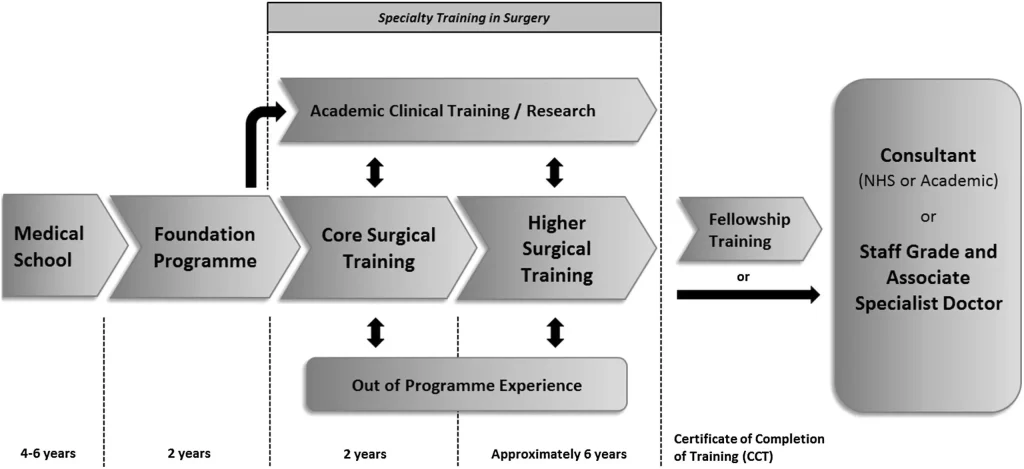
Whichever registration route you use, the training pathway from GMC registration to CCT in General Surgery follows the same structure.
| Stage | Duration | Details |
| MBBS + Rotating Internship (India) | 5.5 + 1 yr | MBBS from NMC-recognised institution. Mandatory rotating internship completed. |
| MRCS Part A (from India) | 6–18 months prep | Pearson VUE centres in India. No GMC registration required to sit. Start early — it benefits every subsequent stage. |
| GMC Registration | 3–6 months | Via UKMLA (AKT + CPSA), full MRCS, Non-PLAB university sponsorship, or ISTP (when relaunched). English language evidence (IELTS/OET) required. |
| Core Surgical Training CT1–CT2 | 2 years | Applied through Oriel. Multiple surgical specialties. MRCS completion required for ST3 progression. Basic salary: £55,355/yr (2026/27). |
| Higher Surgical Training ST3–ST8 | 6 years | Specialty-specific. Competitive entry. MRCS required. Strong portfolio essential. Salary: £67,325–£77,348/yr. |
| FRCS Examination | During ST6–ST8 | Intercollegiate Specialty Examination in General Surgery. Required alongside operative logbook and curriculum completion for CCT. |
| CCT + GMC Specialist Register | — | Entry as Consultant General Surgeon. Return to India as NMC-recognised specialist — no FMGE or NExT required. |
Eligibility for General Surgery in the UK After MBBS
Eligibility depends on which stage you are entering. There is no single checklist that covers GMC registration, CST and ST3 simultaneously.
For GMC Registration (any route)
- Primary qualification: MBBS from an NMC-recognised institution.
- Internship: Completed rotating internship of at least 12 months.
- English language: IELTS Academic 7.5 overall (minimum 7.0 each band) or OET Grade B in all components.
- Route-specific evidence: UKMLA pass, full MRCS, university sponsorship letter, or ISTP approval — depending on your chosen route.
For Core Surgical Training CT1
- Full GMC registration at the time of application.
- Foundation-level competence (demonstrated through UK or equivalent experience).
- 18 months or less of whole-time-equivalent surgical specialty experience at the advertised start date (surgical experience outside the UK counts).
For General Surgery ST3
- Full GMC registration.
- Full MRCS by examination (by the required recruitment deadline).
- Evidence of core surgical competencies — via completed UK CST, or via the Alternative Certificate of Eligibility to Enter Higher Surgical Training for doctors without UK CST.
The 2026 Training Prioritisation Rules: What Changes, What Does Not
International doctors have not been banned from UK specialty training. The Medical Training (Prioritisation) Act 2026, which received Royal Assent on 5 March 2026, requires that prioritised applicants — broadly UK and Irish graduates and certain immigration-status groups — are offered specialty training posts before non-prioritised applicants.
NHS England’s June 2026 data (updated July 2026) reported 33,953 appointable applications for 9,520 specialty training posts, with prioritised candidates filling approximately 98% of positions at that stage. NHS England explicitly states that internationally trained doctors continue to make a major contribution and are not excluded from applying.
The practical message: do not assume GMC registration automatically leads to a training number in the current environment. Relevant NHS experience, MRCS, documented competencies and the correct entry level (CST vs ST3) matter more now than they did two years ago.
This Act does not affect the Non-PLAB university route. The GMC Sponsorship route Career Voyage offers operates through university-based clinical PG programmes — outside the NHS training recruitment system entirely. The prioritisation rules apply to competitive NHS specialty training posts only.
NMC Recognition: Returning to India After UK General Surgery
The UK is one of five countries whose PG medical degrees the NMC recognises directly (Government of India notification, 7 March 2008; NMC communication, 3 July 2019). A UK CCT in General Surgery can be registered as an additional qualification with your State Medical Council, allowing you to practise as a specialist surgeon in India.
On FMGE and NExT: Doctors whose primary MBBS qualification is from an NMC-recognised Indian institution do not need to sit FMGE when returning — FMGE applies to foreign medical graduates. NExT (which is replacing FMGE from 2026, though implementation has been deferred) similarly would not apply to a doctor returning with a recognised UK PG qualification. The recognition pathway is through State Medical Council registration of the UK CCT, not through a licensing exam.
Four things to keep separate: NMC recognition of a UK CCT, specialist registration, screening-test exemption and teaching-post equivalence are not the same legal outcomes. Career Voyage’s UK Medical PG Recognition in India page explains the distinctions in full.
Cost Planning for General Surgery in the UK
Separate your examination costs from your registration costs, and both from optional university study. These are not the same thing.
| Item | Official Fee (GBP) | Approximate INR (8 Aug 2026) |
| UKMLA AKT (was PLAB 1) | £283 | ≈ ₹36,300 |
| UKMLA CPSA (was PLAB 2) | £1,036 | ≈ ₹1.33 lakh |
| MRCS Part A | £650 | ≈ ₹83,400 |
| MRCS Part B | £1,177 | ≈ ₹1.51 lakh |
| GMC Full Registration | Check gmc-uk.org | Subject to annual revision |
| Non-PLAB University Programme | — | ₹15 lakh – ₹75 lakh (Career Voyage programmes) |
Beyond these, budget for English language testing, primary source verification, GMC annual retention, visa costs, travel, initial accommodation and living expenses before your first salary. An MSc or postgraduate diploma from a UK university can be academically valuable — but it is not a mandatory requirement for GMC registration, MRCS, CST or ST3, and should never be presented as one.
Surgical Portfolio Checklist for Indian Doctors Targeting UK Training
For UK surgical recruitment, documented evidence matters more than a broad claim that you have “surgical experience.” Start building this from day one after your internship.
| Evidence to Build | Why It Matters |
| Verified operative logbook | Shows procedures performed, level of involvement and progression over time |
| Workplace assessments (CBD, DOPS, mini-CEX) | Documents observed competency at specific clinical events |
| Supervisor/consultant reference letters | Supports professional and clinical standing |
| Audit or quality improvement projects | Required component of UK surgical training applications |
| Teaching activity and feedback | Demonstrates educational engagement |
| Research or publications | Strengthens academic profile for competitive posts |
| Relevant courses and certifications | ATLS, laparoscopic skills courses, anatomy courses |
| Leadership or governance involvement | Demonstrates wider professional development |
| Reflective practice or CPD records | Shows continued learning and self-awareness |
| CST or ST3 competency mapping | Critical if applying at a defined training level — do this early, not the week before the deadline |
For doctors aiming at ST3 directly, competency mapping is particularly important. Trying to reconstruct several years of overseas training evidence a few weeks before an application deadline is stressful and often incomplete.
General Surgery in the UK: Frequently Asked Questions
Can I pursue General Surgery in the UK without sitting PLAB?
Yes — through more than one route. Full MRCS is currently on the GMC’s list of acceptable postgraduate qualifications and can support a registration application without PLAB/UKMLA. The Non-PLAB university route (GMC Sponsorship) allows eligible doctors to register through their university without any PLAB history. ISTP sponsorship offers a third route. None of these is automatic — all other GMC registration conditions still apply.
Can I sit MRCS Part A from India without GMC registration?
Yes. MRCS Part A is available at Pearson VUE centres in India. It requires only an MBBS degree acceptable to the GMC — no prior registration, no PLAB, no surgical experience required. This is one of the most underused options for fresh MBBS graduates who know they want surgery.
Is MRCS Part B available in India?
RCS England scheduled MRCS Part B OSCE sittings in India during 2026. Availability can change between examination diets — check the RCS England exam calendar before planning around a specific centre or date.
What is the 18-month rule for Core Surgical Training?
CST CT1 applicants must have 18 months or less of whole-time-equivalent surgical specialty experience at the advertised post start date. Foundation placements are excluded. Surgical experience gained outside the UK does count toward this limit. This is a planning issue many doctors discover too late.
Does ISTP require a 3-year postgraduate degree?
No. RCS England’s published eligibility requires a postgraduate medical qualification containing a clinical assessment component — it does not specify a minimum duration for the qualification itself. Separately, ISTP requires at least three years of full-time clinical practice since the primary medical qualification. These are two different criteria.
Can an Indian MS or DNB surgeon apply directly to ST3?
Potentially yes. The doctor must meet the current General Surgery ST3 person specification: full GMC registration, full MRCS by examination, and evidence of required core surgical competencies. Applicants without UK CST use the Alternative Certificate of Eligibility to Enter Higher Surgical Training to provide that evidence. An Indian MS or DNB strengthens your profile but does not by itself create ST3 eligibility.
Does the 2026 Training Prioritisation Act affect the Non-PLAB university route?
No. The Medical Training (Prioritisation) Act 2026 applies to NHS specialty training posts — competitive recruitment through Oriel for CST, ST3 and similar programmes. The Non-PLAB university route that Career Voyage offers operates through university-based clinical PG programmes and is not subject to this Act.
Is UK CCT in General Surgery recognised in India?
Yes — for specialist registration purposes. The Government of India’s 7 March 2008 notification and the NMC’s 3 July 2019 communication confirm that UK CCTs in different clinical branches were approved for registration as additional qualifications. Doctors returning to India with a UK CCT do not need to sit FMGE or NExT. Confirm the current registration procedure with the NMC or your State Medical Council before returning, as administrative processes can change.
Is an MSc in surgery the same as MRCS or CCT?
No. An academic MSc can strengthen research exposure and exam preparation, but it does not provide GMC registration, MRCS, a training number, CCT or specialist registration. Assess any university programme by exactly what qualification it awards and where that sits in your specific career plan.
Is General Surgery in the UK Right for You?
UK General Surgery is better understood as a long-term professional pathway than as a quick alternative to NEET PG. That does not mean it is the wrong choice — for many doctors, it is the right one. But it should be chosen for the right reasons.
Fresh MBBS graduates have one important strategic advantage: the 18-month CST experience rule means early career planning can preserve CT1 eligibility. Start MRCS Part A early. Do not accumulate years of unstructured surgical work in India thinking it will help your UK application — it may close the CT1 door instead.
Experienced surgeons have a different opportunity. Rather than trying to fit back into a pathway designed for someone who graduated last year, MRCS plus competency mapping and ST3 entry may be far more logical.
Before committing, establish five things clearly: whether your goal is UK clinical practice, a UK academic qualification, or both; whether you want CST, ST3 or the Non-PLAB university route; whether your PLAB history makes the university route the best or only option; how much surgical experience you will have at the relevant recruitment date; and whether your eventual plan is UK practice, return to India, or keeping both options open.
Career Voyage can review these questions against your actual profile — not a generic checklist. Call or WhatsApp +91 9650347138.
How Career Voyage Can Help
Career Voyage is an Indian abroad education consultancy based in Ghaziabad, Uttar Pradesh, specialising in UK medical pathways for Indian MBBS graduates and foreign medical graduates. We are an authorised agent for the University of Chester and the University of Dundee.
For General Surgery specifically, we provide:
- Route assessment — PLAB/UKMLA vs MRCS vs Non-PLAB university vs ISTP, based on your actual profile, experience and prior exam history.
- Non-PLAB university admissions — eligibility check, programme selection, application support and GMC Sponsorship documentation for Chester, Dundee, Middlesex and Salford programmes.
- MRCS readiness review — which part to sit first, which Indian centres to target, realistic timeline for your situation.
- ISTP interest registration — Helps in profille building
- GMC registration guidance — documentation checklist, primary source verification, English language requirements.
- Personal statement writing for NHS surgical posts, university applications and training programme applications.
- Pre-visa and interview preparation for students and doctors relocating to the UK.
Contact: +91 9650347138 | WhatsApp: +91 9650347138 | abroadeducationconsultants.co.in
Career Voyage is an authorised agent for the University of Chester and University of Dundee. A route assessment will identify limitations as clearly as it identifies opportunities. We will not promise GMC registration, a training post, an NHS job or NMC recognition — these depend on your individual circumstances and official decisions made by the GMC, NHS and NMC.