MSc Diabetes in the UK is a postgraduate academic qualification focused on diabetes care, prevention, complications, and chronic disease management. Indian MBBS doctors, nurses, pharmacists, and allied health professionals can join these programmes at UK universities to strengthen their diabetes knowledge and clinical profile. This qualification can support careers in diabetes education, clinical research, public health, and private practice — though it is not a replacement for clinical specialist training like MD, DM, or MRCP.
Why Indian Healthcare Professionals Are Looking at MSc Diabetes in the UK
India has one of the world’s largest diabetes populations. According to the IDF Diabetes Atlas 11th Edition (2025), approximately 89.8 million adults aged 20 to 79 in India are living with diabetes. This number is projected to rise sharply over the next two decades. The age-standardised prevalence of diabetes in Indian adults stands at 10.5% as of 2024 and is expected to reach 12.8% by 2050.
What this means for doctors is simple — there is a growing need for healthcare professionals who understand diabetes beyond the basics. Not just diagnosis and insulin prescriptions, but prevention strategies, complications management, patient education, lifestyle interventions, and long-term chronic disease care.
For Indian MBBS graduates who want to build a focused profile in diabetes care without going through the highly competitive NEET PG or NEET SS route in India, an MSc Diabetes in the UK can be a practical academic step. It is also useful for nurses, pharmacists, dietitians, and public health professionals.
If you want to know whether an MSc Diabetes programme in the UK is right for your background and career goals, get in touch with Career Voyage. Our team will review your profile, suggest suitable universities, and explain the application process clearly. Call us or send a WhatsApp message for a free consultation.
What Is MSc Diabetes in the UK — And What It Is Not
If you are an Indian doctor or healthcare graduate exploring MSc Diabetes in the UK, you are probably looking for more than just another postgraduate degree. You want a course that improves your understanding of diabetes care, strengthens your profile, and gives you international academic exposure in a field that is growing very fast.
And honestly, diabetes care is not a small area anymore. India has one of the world’s largest diabetes burdens, and globally, the number of adults living with diabetes is rising sharply. So, a focused postgraduate qualification like MSc Diabetes UK can be a smart academic step for doctors, nurses, pharmacists, dietitians, public health graduates, and other healthcare professionals who want to work in diabetes care, endocrinology support, clinical research, health education, or chronic disease management.
But yes, one thing should be clear from the start. An MSc in Diabetes is mainly an academic postgraduate qualification. It can improve your knowledge and profile, but it is not the same as a UK clinical specialist training qualification like MRCP or a licence to practise medicine independently in the UK or India.
Why Choose MSc Diabetes in the UK
Diabetes is a high-demand healthcare field
Diabetes is no longer limited to hospital endocrinology departments. It is now connected with family medicine, internal medicine, cardiology, nephrology, ophthalmology, nutrition, public health, pregnancy care, wound care, and lifestyle medicine.
That means doctors and healthcare professionals with advanced diabetes knowledge can work in multiple directions.
UK MSc courses are usually focused and structured
Many diabetes postgraduate courses in the UK are designed around modules such as diabetes prevention, complications, clinical management, research methods, patient-centred care, public health, and evidence-based practice.
Some courses are full-time on campus, while others are online or part-time. So, depending on your career stage, you may choose a study format that suits you.
Useful for Indian doctors planning a focused career
For Indian MBBS graduates, MSc Diabetes for Indian doctors can help build a stronger profile in diabetes care, especially if they want to work in diabetes clinics, lifestyle and metabolic health centres, clinical research organisations, public health projects, medical education, hospital-based chronic disease management teams, or healthcare startups and digital health platforms.
Better academic profile for future pathways
An MSc may support your academic profile if you later apply for research roles, PhD options, healthcare leadership roles, or some Royal College-related pathways. However, it should not be treated as a replacement for clinical registration, specialist training, or Royal College qualifications.
Top MSc Diabetes Courses in the UK — University-Wise Comparison
Below are some well-known options for students exploring MSc Diabetes in the UK. Course names, fees, and intakes may change, so you should always verify details on the official university website before applying.
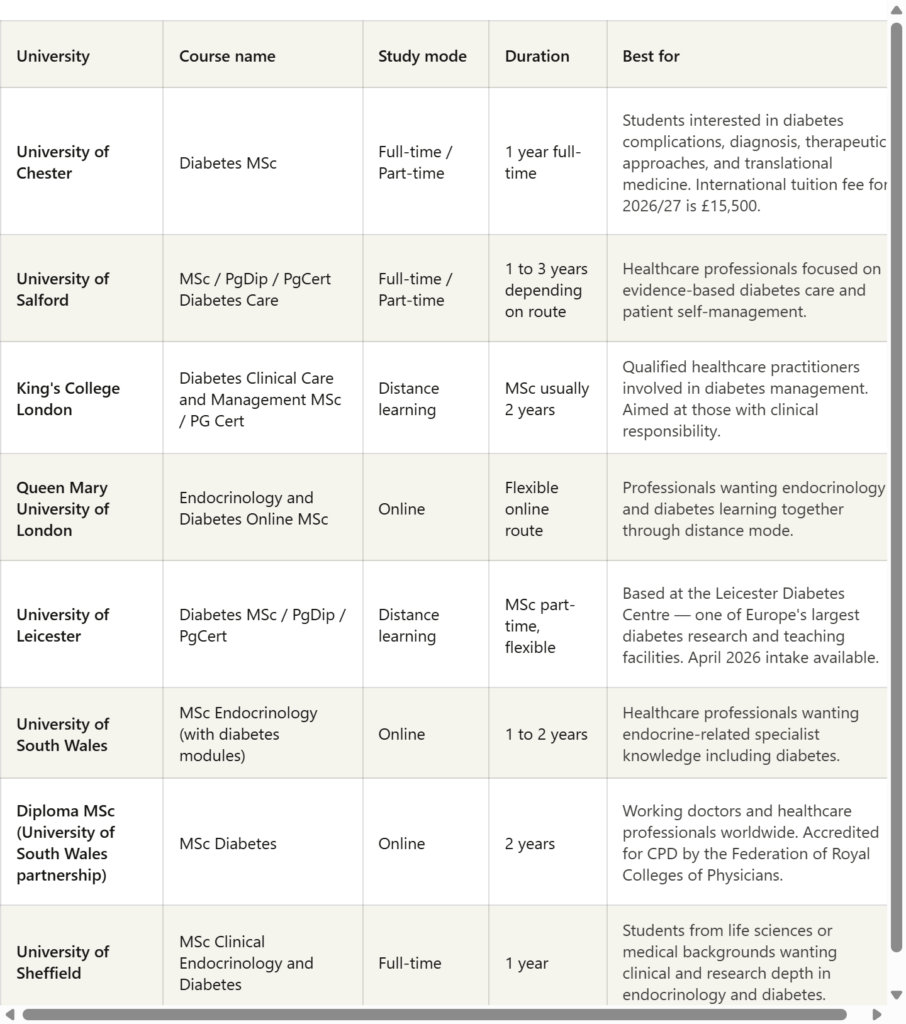
University-Wise Course Details
University of Chester — Diabetes MSc
The University of Chester offers a diabetes-focused MSc that covers types of diabetes, complications, pathophysiology, diagnosis, and therapeutic approaches. For Indian doctors, this is a well-structured option that combines both scientific and clinical perspectives. The course is mapped to the GMC (PLAB) for international doctors, which means course outcomes can be used as evidence for future GMC registration. The international tuition fee for 2026/27 is £15,500 (approximately Rs 16 to 17 lakh depending on exchange rates).
University of Salford — MSc Diabetes Care
The MSc Diabetes Care at the University of Salford is focused on evidence-based diabetes care. It is designed to help healthcare professionals develop knowledge and confidence in supporting people with diabetes. The course covers diabetes care models, patient education, self-management support, critical thinking in healthcare, and research and communication skills. For Indian students, this course can be especially relevant if they want a care-focused postgraduate route rather than a purely laboratory or research-heavy course.
King’s College London — Diabetes Clinical Care and Management MSc
King’s College London offers a distance-learning programme in diabetes clinical care and management. This course is generally aimed at healthcare professionals who already have responsibility for diabetes management. It covers diabetes assessment, interventions, care organisation, specialist and primary healthcare settings, and multidisciplinary diabetes management. Because it is a distance-learning programme, it may suit working professionals who cannot relocate immediately.
Queen Mary University of London — Endocrinology and Diabetes Online MSc
Queen Mary University of London offers an online MSc in Endocrinology and Diabetes. This is worth considering if you want a course that goes beyond diabetes alone and includes endocrinology as a wider subject area. It covers hormonal disorders, diabetes treatment strategies, endocrinology case-based learning, and flexible online postgraduate study.
University of Leicester — Diabetes MSc (Distance Learning)
The University of Leicester’s MSc Diabetes is based at the Leicester Diabetes Centre, one of Europe’s largest facilities for diabetes research and teaching. Leicester is ranked 2nd in the UK for world-leading research in clinical medicine (2021 Research Excellence Framework). The course is delivered through distance learning and allows you to specialise in areas relevant to your practice. The April 2026 intake has an application deadline of 23 March 2026. If you have previously completed relevant postgraduate study, you may be able to transfer credits (up to 60 credits of APL) to shorten the course.
University of Sheffield — MSc Clinical Endocrinology and Diabetes
The University of Sheffield’s MSc covers the role of hormones in regulating key bodily processes, the pathophysiology of endocrine disorders across all stages of life, and diabetes from symptoms and complications to management strategies. It also includes drug development research. You need at least a 2:1 in a relevant life science or medical degree. IELTS requirement is 7.0 overall with 6.5 in each component. This is a campus-based, full-time programme and suits students who can relocate to the UK.
MSc Diabetes vs Diabetes Fellowship vs PG Diploma — Which Should You Choose?
This is a question many Indian MBBS doctors ask, and the answer depends on your career goals, budget, and how much time you can take away from clinical practice.
| Point | MSc Diabetes in UK | Diabetes Fellowship (India-based) | PG Diploma in Diabetes |
|---|---|---|---|
| Qualification Type | Academic postgraduate degree from a UK university | Certificate or fellowship from an Indian institution or online provider | Diploma-level qualification, often online |
| Duration | 1 to 2 years | 6 to 15 months | 6 to 12 months |
| Focus | Academic depth, research, evidence-based care, and chronic disease management | Clinical exposure and practical skills in Indian hospital settings | Knowledge update and guidelines-based learning |
| Best For | Doctors wanting international academic exposure and a UK qualification | MBBS doctors wanting quick specialisation to start or improve a diabetes practice in India | Working doctors wanting to upskill without leaving their practice |
| Recognition | UK university degree recognised internationally and may strengthen CV for global academic or healthcare roles | Recognition depends on the accrediting institution and may vary significantly | Recognition depends on the university or institution offering the programme |
| Approximate Cost | ₹10 lakh to ₹25 lakh including tuition and living expenses for on-campus study | ₹50,000 to ₹3 lakh | ₹1 lakh to ₹5 lakh |
| Clinical Registration | Does not provide clinical registration in the UK or India | Does not provide specialist registration | Does not provide specialist registration |
None of these is a replacement for MD, DM, or DNB in Endocrinology. If you want to become a registered endocrinology specialist in India, you will still need to go through the NEET SS or equivalent route. But if your goal is to build a stronger diabetes-focused practice, any of these can help — depending on your specific situation.
Career Voyage can help you understand which route suits your profile and goals. If you are confused between an MSc Diabetes in the UK and other options, speak to our team before making a decision.
Eligibility for MSc Diabetes in UK for Indian Doctors
Eligibility varies by university, but most MSc Diabetes in the UK courses may ask for a relevant healthcare, medical, biomedical, nursing, pharmacy, nutrition, or allied health qualification.
For Indian applicants, common requirements may include: MBBS, BDS, BAMS, BHMS, BPT, BSc Nursing, Pharmacy, Life Sciences, Biomedical Science, Nutrition, or related healthcare degree; academic transcripts; Statement of Purpose; academic or professional references; updated CV; IELTS / UKVI IELTS / TOEFL / PTE (depending on university rules); and clinical or healthcare experience if required by the course.
Most universities accept IELTS 6.0 to 6.5 overall. Some programmes — especially those at research-intensive universities like Sheffield — require IELTS 7.0 with 6.5 in each component. If your IELTS score is slightly below the requirement, some universities offer pre-sessional English courses.
For some courses, especially clinical care-focused or advanced professional programmes, universities may prefer applicants who are already qualified healthcare practitioners or have responsibility for diabetes-related patient care.
How to Apply for MSc Diabetes in UK — Step by Step
Step 1: Decide your study mode and budget. Do you want to study full-time on campus in the UK, or do you prefer an online or distance-learning programme? On-campus courses give you the UK university experience and access to NHS clinical exposure, but they cost more when you add living expenses and visa fees. Online courses let you continue working in India while studying.
Step 2: Shortlist 3 to 5 universities based on your profile. Look at the course structure, fees, entry requirements, IELTS score needed, and whether the course includes a dissertation or research project. Career Voyage can help you shortlist universities that match your background and career goals.
Step 3: Prepare your documents. You will typically need your passport, academic transcripts, degree certificate, internship completion certificate (if applicable), medical registration certificate (if applicable), updated CV, Statement of Purpose, letters of recommendation, English language score, and work experience documents if required.
Step 4: Write a strong Statement of Purpose. This is very important because universities want to understand why you are choosing diabetes, how your background fits the course, and what your future plan is. Do not write a generic SOP — mention specific aspects of the course that interest you and connect them to your career plan.
Step 5: Submit your application. Most UK universities accept applications through their own online portal. Some courses also accept applications through UCAS for postgraduate courses. Apply at least 6 to 8 months before the intake to give yourself time for visa processing.
Step 6: Accept your offer and apply for a visa. If you are studying on campus, you will need a Student visa (formerly Tier 4). You will need to show proof of funds, pay the Immigration Health Surcharge (IHS), and attend a biometric appointment. Career Voyage can guide you through the visa documentation process.
Step 7: Prepare for departure. Book accommodation, arrange travel, and get familiar with the city and university campus. If you are studying online, set up your study schedule and make sure you have reliable internet access for live sessions and assessments.
MSc Diabetes UK Fees for Indian Students
Fees vary by university, course mode, and intake year. As a rough range, international students may expect tuition fees from approximately £9,000 to £22,000 or more, depending on whether the course is online, part-time, or full-time on campus.
To give you a clearer picture in Indian rupees (at an approximate exchange rate of Rs 108 to £1):
University of Chester (Diabetes MSc, full-time): £15,500 — approximately Rs 16.7 lakh tuition only. King’s College London (distance learning): Check the official university website for current fees. University of Leicester (distance learning): Fees are typically lower for distance-learning programmes. Online programmes (Diploma MSc, Queen Mary online): These may charge per year or per module and are generally more affordable than full-time campus-based courses.
Some online or distance-learning courses may charge per year or per module. Some full-time campus-based programmes may have higher total costs when living expenses are included.
Students should budget for tuition fees, visa fee (if studying on campus), Immigration Health Surcharge (if applicable), accommodation, food and local travel, study materials, and initial settlement cost.
Scholarships for MSc Diabetes in the UK
Indian students may explore different scholarship options, including university-specific international scholarships, GREAT Scholarships (if available for the university and course), Commonwealth-related funding (where applicable), early payment discounts, alumni discounts, country-specific bursaries, and merit-based postgraduate awards.
Scholarships are competitive, and deadlines may close early. So, it is better to start shortlisting at least 8 to 10 months before your planned intake. Career Voyage can help you identify which scholarships you are eligible for and guide you through the application process.
Is MSc Diabetes in the UK Valid in India?
This is a very important question, and you should understand it clearly.
An MSc Diabetes in the UK is generally an academic postgraduate qualification awarded by a UK university. It can strengthen your academic profile, improve your subject expertise, and support your career in diabetes education, clinical research, healthcare management, public health, or private diabetes care support.
However, it is not the same as an Indian MD/MS/DM qualification. It does not automatically make someone a registered specialist doctor in India. If you are an MBBS doctor already registered in India, you may use your existing registration to practise medicine as permitted by Indian regulations, but the MSc itself should be presented as an academic qualification, not as a specialist medical registration.
For government jobs, teaching posts, specialist titles, and regulatory recognition, you should always check the latest NMC, state medical council, and employer rules.
One important point for Indian doctors: if you complete a postgraduate clinical degree from the UK (such as an MD or MS), you may be exempt from clearing the FMGE or NExT exam to practise in India. The FMGE exam is being replaced by the NExT exam from 2026 onwards. However, this exemption applies specifically to clinical PG degrees — not to academic MSc qualifications. So, do not confuse MSc Diabetes with a clinical MD from a UK university. These are different pathways. Career Voyage can explain the exact difference and help you choose the right one.
Can MSc Diabetes Help with UK Medical Career Pathways?
Yes, it can help academically, but with limitations.
An MSc Diabetes UK course can improve your knowledge, research exposure, academic confidence, and healthcare communication skills. It may also strengthen your CV for future applications in research, healthcare roles, public health, or further study.
But it does not replace GMC registration, PLAB/UKMLA or other GMC-approved registration routes, Royal College exams like MRCP, UK specialty training, or NHS clinical licensing requirements.
Important update for 2026: The PLAB 2 exam has been replaced by the CPSA (Clinical and Professional Skills Assessment) from 2024. The full GMC registration test is now called UKMLA (UK Medical Licensing Assessment), which combines AKT (Applied Knowledge Test) and CPSA. If your goal is to work as a doctor in the UK, you must plan your registration pathway separately through UKMLA or the GMC Sponsorship route.
The GMC Sponsorship route is another pathway that does not require PLAB or UKMLA — but it is not open to doctors who have previously appeared and failed the PLAB exam. Career Voyage specialises in helping Indian MBBS doctors get into UK clinical PG programmes through the GMC Sponsorship route. If this is something you are interested in, speak to our team.
After completing your MSc, you can apply for the Graduate Route visa, which gives you 2 years to stay and work in the UK after completing your degree. This can be useful for gaining experience in diabetes research, public health, or NHS-related roles.
Career Opportunities After MSc Diabetes UK
After completing MSc Diabetes in the UK, career options depend on your previous qualification, work experience, registration status, visa position, and country of employment.
Diabetes Care Practitioner
Diabetes Educator Healthcare professionals may work in diabetes education, patient counselling, lifestyle modification, and long-term disease management support.
Clinical Research Roles
Students with strong academic and research skills may explore clinical research organisations, pharmaceutical companies, diabetes trials, data collection, and healthcare research projects.
Public Health and Chronic Disease Management
Diabetes is a major public health concern. Graduates may work in prevention programmes, awareness campaigns, community health projects, and non-communicable disease initiatives.
Hospital or Clinic-Based Diabetes Support Roles
Depending on your registration and professional background, you may work in diabetes clinics, metabolic health centres, wellness clinics, or multidisciplinary care teams.
Teaching and Academic Roles
Some graduates may use the MSc to move into teaching, training, healthcare education, or further research.
Private Practice
Profile Enhancement for Indian Doctors For Indian doctors already eligible to practise in India, a UK MSc in Diabetes can add academic credibility to their diabetes-focused practice. Many doctors use this qualification to set up dedicated diabetes clinics, offer specialised diabetes counselling, or position themselves as diabetes care experts in their city. All titles and claims should be used carefully and ethically.
Online MSc Diabetes UK — Is It a Good Option?
Yes, an online MSc Diabetes UK can be useful, especially for working doctors and healthcare professionals who cannot leave their job or relocate immediately.
Online courses may help you continue working while studying, avoid UK living expenses, build international academic exposure, study with flexibility, and focus on diabetes or endocrinology without taking a career break.
However, you should check whether the course includes live sessions, recorded lectures, assessments, clinical case learning, supervisor support, and final dissertation or project requirements. Not all online courses are the same — some are more rigorous and interactive than others.
The Diploma MSc programme (delivered in partnership with the University of South Wales) offers a fully online MSc Diabetes that is accredited for CPD by the Federation of Royal Colleges of Physicians. This is a strong option for Indian doctors who want a recognised online qualification without relocating.
Documents Required for MSc Diabetes UK Admission
You will usually need: passport, academic transcripts, degree certificate, internship completion certificate (if applicable), medical registration certificate (if applicable), updated CV, Statement of Purpose, letters of recommendation, English language score, work experience documents (if required), and course-specific supporting documents.
A strong SOP is very important because universities want to understand why you are choosing diabetes, how your background fits the course, and what your future plan is.
How Career Voyage Helps You Apply for MSc Diabetes in the UK
Career Voyage helps Indian doctors and healthcare graduates shortlist suitable UK universities for MSc Diabetes in the UK based on academic profile, budget, career goals, and preferred study mode.
Our support may include: course and university shortlisting, eligibility assessment, SOP guidance, CV review, application support, scholarship guidance, offer letter follow-up, visa documentation guidance, pre-departure support, and career pathway counselling after admission.
Career Voyage also helps Indian MBBS doctors with other UK medical pathways — including Clinical MD and MS in the UK without PLAB, MRCP and MRCS pathway guidance, GMC Sponsorship route admissions, Medical Training Initiative (MTI), clinical internships and electives in UK NHS hospitals, and UK fellowship programmes in Cardiology, Diabetes, Respiratory Medicine, and Oncology. If you are not sure whether MSc Diabetes is the right choice for you, or whether a clinical PG route might be better, Career Voyage can help you compare your options.
We focus on legally safe, realistic counselling. No false promises, no confusing claims.
To check your eligibility and understand which UK university and programme is right for you, contact Career Voyage. We have helped many Indian MBBS doctors and foreign medical graduates get admission to top UK universities. Call us or WhatsApp for a free consultation.
Frequently Asked Questions About MSc Diabetes in the UK
Is MSc Diabetes in the UK suitable after MBBS?
Yes, many MBBS graduates choose MSc Diabetes in the UK to deepen their academic knowledge of diabetes care, complications, prevention, and chronic disease management. It is a well-regarded academic qualification from a UK university. However, it is not a replacement for MD, DM, or clinical specialist registration in India or the UK. If you are looking for clinical specialist training instead, Career Voyage can help you explore Clinical MD programmes in the UK.
Can Indian doctors practise in the UK after completing MSc Diabetes?
Not automatically. To work as a doctor in the UK, you generally need GMC registration through an approved route. The older PLAB 2 exam has been replaced by CPSA from 2024, and the full test is now called UKMLA (AKT + CPSA). The GMC Sponsorship route is another option — but it is not available to doctors who have previously failed the PLAB exam. MSc Diabetes strengthens academic knowledge but does not provide GMC registration on its own.
Is MSc Diabetes from a UK university valid in India?
It is a UK university academic qualification that can improve your profile, strengthen your diabetes-care expertise, and support your career in education, research, or private diabetes practice. However, it should not be treated as an Indian specialist medical qualification like MD or DM. For government jobs, teaching posts, or specialist titles, always check current NMC and state medical council rules.
What is the fee for MSc Diabetes in the UK for Indian students?
Fees vary by university and study mode. International students should expect tuition fees ranging from approximately £9,000 to £22,000 or more. In Indian rupees, this works out to roughly Rs 10 lakh to Rs 24 lakh for tuition alone. The University of Chester charges £15,500 for international students in 2026/27. Online and distance-learning courses are generally more affordable than full-time campus-based programmes.
Are there online MSc Diabetes courses available in the UK?
Yes. King’s College London, Queen Mary University of London, University of Leicester, and the Diploma MSc programme (University of South Wales partnership) all offer online or distance-learning options. These are suitable for working doctors and healthcare professionals who want to study while continuing their clinical practice in India.
What is the difference between MSc Diabetes and a Diabetes Fellowship?
An MSc Diabetes is a university-awarded academic degree, usually lasting 1 to 2 years, that includes a research dissertation and gives international academic credibility. A Diabetes Fellowship is a shorter certificate-based programme (6 to 15 months) focused on clinical skills and practical training, often offered by Indian institutions. Neither replaces MD, DM, or DNB. The right choice depends on whether you want academic depth or quick clinical upskilling.
Do I need to clear FMGE or NExT after completing MSc Diabetes from the UK?
If you already have Indian MBBS registration, you can continue practising in India using your existing registration. The MSc does not change that. The FMGE/NExT exemption applies to doctors who complete a clinical PG degree (like MD or MS) from a recognised country — not to academic MSc qualifications. The FMGE exam is being replaced by NExT from 2026. For clinical PG options in the UK that qualify for NExT exemption, contact Career Voyage.
Can MSc Diabetes help with MRCP or Royal College pathways?
An MSc can strengthen your academic profile and subject understanding, which may support future MRCP preparation or Royal College applications. However, it does not replace MRCP exams, GMC registration, or UK specialty training. The University of Chester has mapped its MSc Diabetes course to the GMC PLAB, meaning course outcomes can serve as supporting evidence for future GMC registration.
Which is better — MSc Diabetes or MSc Endocrinology and Diabetes?
MSc Diabetes focuses specifically on diabetes care, prevention, complications, and management. MSc Endocrinology and Diabetes covers diabetes along with broader hormone-related disorders including thyroid, adrenal, and reproductive endocrinology. If your career goal is specifically diabetes care and chronic disease management, the focused MSc Diabetes may be better. If you want broader endocrinology knowledge, the combined programme would suit you.
How can Career Voyage help me apply for MSc Diabetes in the UK?
Career Voyage helps Indian doctors and healthcare graduates with course and university shortlisting, eligibility assessment, SOP guidance, CV review, application support, scholarship guidance, offer letter follow-up, visa documentation, and pre-departure support. We also help doctors understand whether an MSc Diabetes or a Clinical MD in the UK without PLAB is the better fit for their career. Call or WhatsApp us for a free consultation.
Final Advice — Should You Study MSc Diabetes in the UK?
If you are serious about diabetes care, chronic disease management, clinical research, public health, or building a focused medical profile, MSc Diabetes in the UK can be a meaningful option.
But choose the course carefully. Some programmes are better for working professionals. Some are stronger for research. Some are online. Some need clinical responsibility. And some may suit Indian doctors better than others depending on long-term goals.
So, before applying, compare the university, course structure, fee, study mode, eligibility, and future pathway properly.
For personalised guidance, contact Career Voyage on WhatsApp or call us for MSc Diabetes UK admission support. We can also help you understand whether a Clinical MD in the UK without PLAB might be a better fit for your career — many of our students initially consider MSc but end up choosing the clinical PG route after understanding the options.