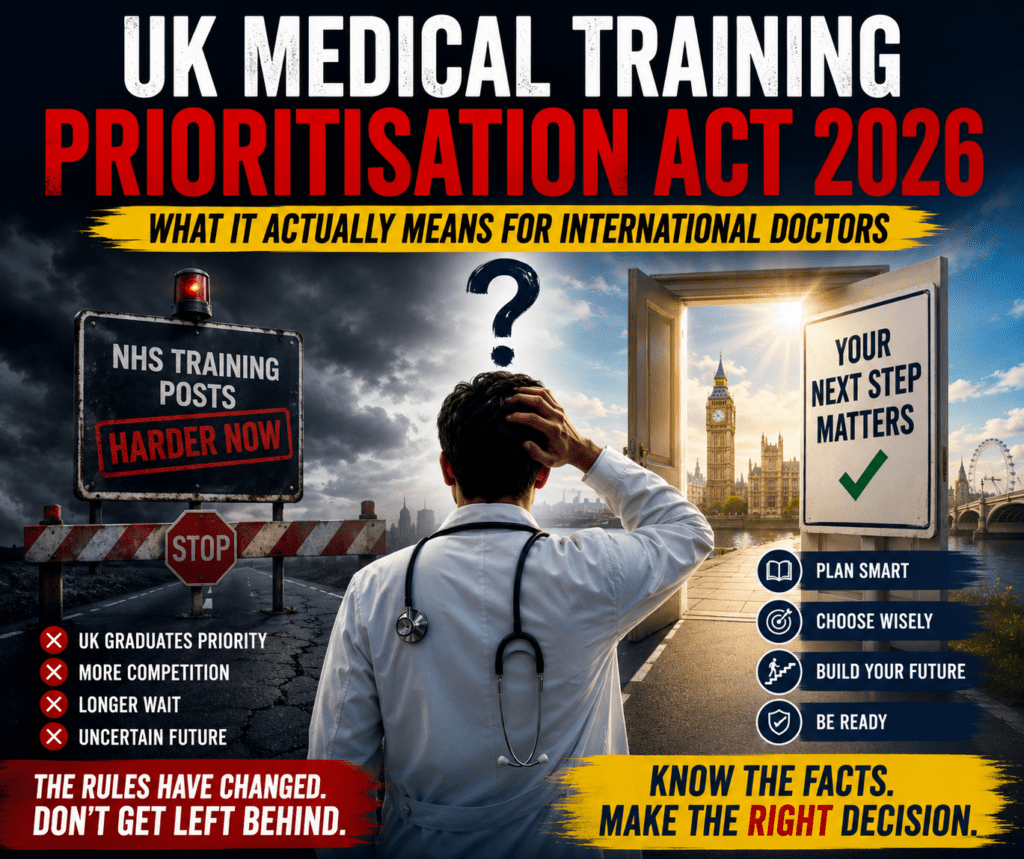
The UK Medical Training Prioritisation Act 2026 hit a lot of doctors like a punch they did not see coming.You worked hard for this. Months of preparation for PLAB 1. A flight to Manchester for PLAB 2. The fees, the anxiety, the waiting. Then finally — your GMC registration. Maybe you had already started applying to NHS jobs. Maybe you were researching cities, calculating rent, mapping out which specialty to aim for. The UK felt close. Real. Within reach.
Then March 2026 arrived, and so did this law. UK graduates get priority for training posts. Just like that, the ground shifted — and for thousands of international doctors, a career plan built over years suddenly felt uncertain.
If that is where you are right now, keep reading. Because what the headlines told you and what this law actually says are two very different things.
If you are reading this — from India, Pakistan, Egypt, Nigeria, the Philippines, Bangladesh, Nepal, Sri Lanka, or anywhere in the Middle East — and you are wondering whether everything you worked for was a waste, we want you to read this page carefully. Because the situation is not what the headlines made it sound like.
Some doors did get harder to open. That is true, and we will tell you exactly which ones.
But one very important door — the one that leads to a full postgraduate medical degree from a UK university, NMC recognition, hands-on NHS training, and a career that no exam back home can block — that door was never part of this law. It is still wide open. And the doctors who understand this right now, while everyone else is panicking, will have the biggest advantage of all.
Career Voyage works specifically with international MBBS doctors who want to do their Medical PG in the UK. If you want to know — honestly and clearly — whether you still have a path, call us or WhatsApp us for a free consultation. No pressure, no commitment. Just a straight conversation about your options.
What Exactly Is the UK Medical Training Prioritisation Act 2026?
The Medical Training (Prioritisation) Act 2026 is a UK law that gives graduates of UK and Irish medical schools priority access to NHS foundation programme places and NHS specialty training posts. It became law on 5 March 2026 after being fast-tracked through Parliament.
Here is why it happened, in simple terms.
Since the UK government removed visa restrictions for doctors in 2020, the number of doctors applying for specialty training exploded. In 2019, about 12,000 doctors applied for specialty training. By 2025, that number had reached nearly 40,000 — but the number of available training posts stayed around 12,000 to 13,000. UK medical graduates, after spending years and significant taxpayer money getting their degrees, were struggling to get into the very training posts they had been educated for.
The government’s response was this Act. It says: for NHS training posts, UK graduates are considered first. After them, doctors with certain immigration statuses — like indefinite leave to remain, British citizenship, or EU settled status — are next. International medical graduates without these credentials are considered last, only if seats remain after the priority groups have been placed.
From 2027, this prioritisation will also apply at the shortlisting and interview stage — not just at the final offer stage. The government has also said it will define “significant NHS experience” in future regulations, which may allow some long-serving IMGs to eventually access the priority group.
That is the law. Those are the facts. No exaggeration in either direction.
Now let us talk about what this law does NOT do — because this is where the real story begins.
Five Things This Law Does NOT Change — Read This Carefully
There is so much confusion right now. Doctors in WhatsApp groups are sharing half-truths. Social media is full of fear. So let us be very specific about what remains completely unaffected.
GMC registration is not touched.
The law says nothing about who can register with the GMC. If you clear UKMLA (the new name for the PLAB framework — PLAB 2 has been replaced by the CPSA exam since 2024), you still get GMC registration. If you have a recognised postgraduate qualification like MRCP or MRCS, you can still register through the PGQ route. Nothing about registration has changed.
NHS non-training jobs are not touched.
Trust grade roles, clinical fellow positions, locally employed doctor (LED) posts, SHO jobs, registrar-level service posts — all of these are completely outside the scope of this Act. The NHS still depends on international doctors to fill these positions across the country. According to the GMC’s own workforce report, international doctors make up a major part of the current NHS workforce in specialties like General Practice, Psychiatry, Geriatrics, and Emergency Medicine.
University-based postgraduate programs are not touched.
This is the one that matters most for Career Voyage clients. Clinical MD programs, MS programs, MCh programs, MSc in Medicine — these are academic degrees offered by UK universities. They are not NHS specialty training posts. They were never part of the NHS recruitment system. The Prioritisation Act does not mention them, does not govern them, and does not affect them in any way.
The GMC Sponsorship route is not touched.
The GMC Sponsorship route — where a Royal College or NHS Trust sponsors an international doctor — remains open. It is a separate pathway and is not part of the foundation or specialty training system covered by this Act. One thing to remember: this route is not available to doctors who have previously appeared for and failed the PLAB exam.
The Medical Training Initiative (MTI) is not touched.
MTI placements — where international doctors come to the UK for structured training under Royal College supervision — continue exactly as before.
So what did the law actually close? One specific pathway: the route where an IMG clears PLAB, gets GMC registration, works in non-training NHS posts, and then applies competitively for NHS specialty training alongside UK graduates. That route just became significantly harder for doctors without existing NHS experience or priority immigration status.
But the pathway through a UK university — direct admission, no PLAB needed, no competition with UK graduates for NHS seats — that was always a different road entirely. And it is still there.
Let Us Be Honest About Something
We are not going to pretend nothing happened. Something real did change.
If you were planning to clear PLAB, move to the UK, work as a trust grade doctor for a year or two, and then apply for specialty training — yes, that plan just became harder. Not impossible, but harder. The numbers speak clearly: nearly 47,000 applicants for roughly 13,000 posts, and now UK graduates are seen first. For an international doctor without existing NHS experience, the odds of entering specialty training through this route have reduced.
And for many doctors who are still in their home countries preparing for PLAB, the honest question to ask is: does it make sense to invest 2 to 3 years and significant money into a pathway where the competition just got structurally harder?
That honest question is also where the opportunity lives.
Because the doctors who are willing to look at the full picture — instead of just the headline — will see something that most others are missing right now.
The University PG Route Was Always the Smarter Path for Many Doctors. Now It Might Be the Only Smart Path.
Long before this Act existed, thousands of international doctors chose the university route over the PLAB route. They did this for clear, practical reasons:
No entrance exam. You do not need PLAB, UKMLA, NEET, NExT, or any other qualifying test to join a university-based MD or MS in the UK. Admission is based on your MBBS degree, your clinical experience, your personal statement, and your English language score.
No competition with UK graduates for NHS seats. University admissions are handled by the university itself. You apply to the university. The university decides. NHS England is not involved. The Prioritisation Act is not relevant.
Hands-on NHS hospital training included. Most clinical MD and MS programs include placements at NHS hospitals as part of the curriculum. You train in real NHS wards, with real patients, under real consultants. You gain NHS experience as part of your degree — not after years of trying to get a foot in the door.
NMC India recognition. The UK is one of only five countries where completing a PG degree exempts you from the FMGE or NExT exam in India. If you complete your MD or MS from a UK university, you can return to India and practice without clearing any screening exam. NMC India recognises the degree. This is a massive advantage — and it has nothing to do with NHS training posts.
The Prioritisation Act changed nothing about this route. Zero.
Many Universities offers Clinical MD in Internal Medicine that includes training at NHS hospitals in partnership with the Royal College of Physicians, London. The University of Dundee offers an MCh in Orthopaedic Surgery accredited by the Royal College of Surgeons of England. Middlesex University London and the University of Salford in Manchester also admit international doctors for postgraduate medical programs.
These universities are still enrolling. Their programs are still running. Their NMC recognition is still intact.
A Message for Doctors Who Are Sitting and Waiting Right Now
We know what is happening in the community. We talk to doctors every single day.
Some of you cleared PLAB months ago and were about to book your flight. Now you are frozen. You are reading every article, watching every YouTube video, scrolling through Reddit threads at 2 AM, and the more you read, the more confused you get. So you are doing the most dangerous thing a doctor can do with their career — nothing. You are waiting for someone to tell you everything is fine.
We are not going to tell you everything is fine. We are going to tell you something better: the situation is clear, and there are specific things you can do about it right now.
If your goal is to work in the NHS at a non-training level — clinical fellow, trust grade, SHO — the Prioritisation Act does not affect you. Apply for jobs. You still can.
If your goal is a structured postgraduate qualification that is recognised in the UK and back home — apply for a university-based MD or MS. The admissions are open. The programs exist. The recognition is confirmed.
If you are stuck between the PLAB route and the university route and you do not know which one makes sense for your profile — talk to someone who knows both routes well.
Career Voyage has guided international MBBS doctors through the university PG route for years. We know the eligibility requirements, the application timelines, the fee structures, the visa process, and the clinical training arrangements. We also know which route does not make sense for certain profiles — and we will tell you that honestly.
Call us or WhatsApp us. One conversation. Free. No forms to fill. No high-pressure follow-ups. Just a clear picture of where you stand and what you can do next.
How to Join a UK University PG Program — The Actual Steps
Step 1: Check your eligibility. You need an MBBS or equivalent from a recognised medical university, and usually 1 to 2 years of clinical experience after graduation. No entrance exam is needed. No PLAB. No UKMLA. No NExT.
Step 2: Choose your specialty. Clinical MD in Internal Medicine, MS in General Surgery, MCh in Orthopaedics, PG in Gynaecology, Paediatrics, Dermatology, Radiology, Psychiatry, Emergency Medicine — UK universities offer a range of specialties. Career Voyage can help you match your background to the right program.
Step 3: Prepare your application. You will need your MBBS degree certificate, academic transcripts, IELTS or OET score (most programs ask for IELTS 7.0 or OET Grade B), a personal statement, and 1 to 2 references from senior clinicians.
Step 4: Apply to the university and receive your offer. Universities manage their own admissions. Career Voyage can help you through this process — we know what each university looks for and how to present your profile clearly.
Step 5: Apply for your UK Student Visa. Once you have your university offer letter and CAS number, you apply for a Student Visa. The process is straightforward and the university’s international office provides guidance.
Step 6: Arrive in the UK and begin your PG degree. Your program will include academic modules, clinical rotations at NHS hospitals, research components, and supervised training. This is a real medical postgraduate education — not a classroom-only degree.
Step 7: Complete your degree and choose your next step. With a UK university PG degree, you can apply for GMC registration through the postgraduate qualification (PGQ) route — without PLAB. You can stay in the UK and work. Or you can return to India, where NMC recognises your degree and exempts you from NExT.
For Indian Doctors Specifically — This Is Why the UK Still Makes Sense
We know that the largest group of readers on this page will be Indian MBBS graduates. So let us address your specific concerns directly.
NEET PG competition in India is brutal. Over 2 lakh doctors compete for roughly 45,000 to 50,000 government PG seats every year. Private medical college PG fees often reach Rs 1 crore or more — with a donation on top of that. Many qualified doctors go 2 or 3 years without getting a seat.
NExT exam is replacing FMGE from 2026. If you are a foreign medical graduate who studied outside India, you will now have to clear NExT to practice in India. Pass rates for FMGE have historically been around 15 to 20 per cent — and NExT is expected to be at least as difficult.
But here is the thing: if you complete your PG from the UK, you do not need to appear for NExT at all. NMC India exempts doctors with recognised PG degrees from the UK, USA, Canada, Australia, and New Zealand. The UK is the most accessible of these five countries for Indian doctors — no donation, no entrance exam, fees starting from approximately Rs 15 lakh.
The Prioritisation Act does not change any of this. Not one part.
For Doctors in Pakistan, Egypt, Nigeria, Philippines, Bangladesh, Nepal, and the Middle East
This article is not written only for Indian doctors. The Prioritisation Act affects every international medical graduate, no matter which country you are from.
If you are from Pakistan, Bangladesh, Nepal, Sri Lanka, Egypt, Nigeria, the Philippines, Sudan, Iraq, or any country in the Middle East — and you were preparing for PLAB or already have GMC registration — the same facts apply to you.
The PLAB → specialty training route just got harder. But the university PG route is completely unaffected. You can still apply to UK universities for a Clinical MD, MS, or MCh. You still get hands-on NHS training. You still earn a globally respected qualification. And depending on your home country’s medical council rules, a UK PG degree may give you recognition and exemptions that would take years to get through other pathways.
Career Voyage has helped doctors from across South Asia and the Middle East. If you want to know how the university route works for your country and your specific qualifications, talk to us.
The Doctors Who Move First Will Benefit the Most
Every time a major policy changes, the same pattern plays out. First, there is panic. Then there is confusion. Then most people freeze and wait. And then a small group of doctors — the ones who read the details, understood the facts, and made a decision while others were still scrolling through fear — they move forward and get the seats, the admissions, and the head start.
Right now, many international doctors are delaying their UK plans because of the Prioritisation Act. Some are dropping out of PLAB preparation entirely. Some are pausing university applications because they are not sure if “the UK is still worth it.”
That means less competition for university PG seats right now. The doctors who apply in this window — while others are hesitating — may find the admissions process faster, the seats more available, and the start of their UK career less crowded than it would have been six months ago.
That is not a sales pitch. That is just what happens when fear creates a gap and clarity fills it.
Frequently Asked Questions — UK Medical Training Prioritisation Act 2026
What is the UK Medical Training Prioritisation Act 2026?
The Medical Training (Prioritisation) Act 2026 is a UK law passed on 5 March 2026 that gives priority access to NHS foundation and specialty training posts to graduates of UK and Irish medical schools. Applications for specialty training rose from 12,000 in 2019 to nearly 47,000 in 2026, while training posts stayed flat — which is why the government acted. The law does not affect university-based PG programs, GMC registration, or NHS non-training posts.
Does the Prioritisation Act stop international doctors from doing MD or MS in the UK?
No. University-based postgraduate programs — Clinical MD, MS, MCh, MSc in Medicine — are academic degrees offered by UK universities. They are completely outside the scope of this Act. International doctors from India, Pakistan, Nigeria, Egypt, the Philippines, Bangladesh, Nepal, Sri Lanka, and the Middle East can still apply and enrol in these programs. University admissions are handled by the universities, not NHS England. For a detailed eligibility check, get in touch with Career Voyage.
Can international doctors still get GMC registration after this Act?
Yes. GMC registration is completely unaffected by the Prioritisation Act. International doctors register through UKMLA (which replaced the PLAB framework from 2024 — PLAB 2 is now the CPSA exam), through the postgraduate qualification route using MRCP or MRCS, or through the GMC Sponsorship route. The law only governs who gets priority for NHS training posts — not who can register as a doctor in the UK.
I cleared PLAB and have GMC registration. Was it all a waste?
Not at all. Your GMC registration is permanent and allows you to work in any NHS non-training role — trust grade, clinical fellow, locally employed doctor positions — all of which are unaffected by this Act. Your registration also opens MRCP and MRCS pathways. What changed is that formal specialty training posts now prioritise UK graduates. But the registration itself remains fully valuable.
Will completing PG from a UK university still exempt me from NExT exam in India?
Yes. NMC India recognises PG degrees from approved UK universities. Doctors who complete a Clinical MD, MS, or MCh from these universities do not need to appear for the NExT exam (replacing FMGE in 2026) to practice in India. This recognition policy is set by NMC India and is entirely separate from UK NHS legislation. The Prioritisation Act has no bearing on this benefit at all.
Does the Act affect the GMC Sponsorship Route?
No. The GMC Sponsorship Route is a separate pathway where a Royal College or NHS Trust sponsors an international doctor. It is not governed by the Prioritisation Act. One important point: the GMC Sponsorship route is not available to doctors who have previously appeared for and failed the PLAB exam. If you have never attempted PLAB, this route remains open to you.
How much does it cost to do Medical PG at a UK university?
Fees for university-based MD, MS, and MCh programs in the UK range from approximately Rs 15 lakh to Rs 75 lakh depending on university, specialty, and duration. There is no entrance exam, no donation, and no capitation charge — admission is based on your academic and clinical profile. For specific fee details for each university, contact Career Voyage for a free consultation.
I failed NExT or FMGE in India. Can I still pursue PG in the UK?
Yes. The university-based PG route in the UK does not require FMGE or NExT. If you have an MBBS from a recognised university and relevant clinical experience, you can apply directly for a Clinical MD, MS, or MCh at a UK university. Completing the degree then exempts you from NExT when you return to India. Many doctors who struggled with FMGE choose this route exactly because it bypasses those exams entirely.
Which UK universities still admit international doctors for Medical PG in 2026?
Several UK universities continue to admit international doctors, including the University of Chester for Clinical MD in Internal Medicine, the University of Dundee in Scotland for MCh Orthopaedic Surgery, Middlesex University London, and the University of Salford in Manchester. These universities manage their own international admissions independently — the Prioritisation Act does not affect their intake. Career Voyage can guide you on which program suits your profile.
Is the UK still a good option for international doctors after the Prioritisation Act?
For doctors pursuing university-based PG degrees — MD, MS, MCh — yes, without question. Those programs are entirely unaffected. The UK still offers NMC-recognised qualifications, NHS hospital training, NExT exam exemption for Indian doctors, and globally respected Royal College pathways. For the PLAB → specialty training route, the landscape is more competitive. The right answer depends on your goal. Talk to Career Voyage to figure out which route fits your situation.
Your Next Step — Talk to Someone Who Knows
You have read the facts now. You know what changed and what did not. You know which pathway is affected and which one is not.
The question left is personal: what does this mean for your specific profile, your qualifications, your career plan, and your budget?
That is a conversation, not an article. And Career Voyage is ready to have it with you.
We have helped international MBBS doctors from India, Pakistan, Nepal, Bangladesh, Sri Lanka, and the Middle East get admission to Clinical MD, MS, MCh, and fellowship programs at top UK universities — without PLAB, without entrance exams, and without the uncertainty of the NHS training post lottery.
Call us or send a WhatsApp message. The consultation is free. Tell us about your background, your goals, and your concerns. We will tell you — clearly and honestly — which programs you are eligible for and what the next step looks like.
The doctors who act on facts while others react to fear will always be ahead. You have the facts now.
Your move.
Best Options after UK Medical Training Prioritisation Act 2026:
Trouble Finding NHS Job After PLAB 2
Passed PLAB 2 – How to Find Your First Job in NHS