PLAB is usually the better route if you want to reach the UK quickly and start working; MRCP is better if you are committed to a physician specialty and want a qualification that counts towards higher training. PLAB (now aligned with the UKMLA) is a licensing exam that gets you GMC registration and an NHS job. MRCP is a postgraduate membership qualification that carries more weight for Core Medical Training but is harder for international graduates to pass. Many Indian doctors do PLAB first, then MRCP while earning an NHS salary. A third option — the GMC Sponsorship route — needs neither exam for admission.
PLAB and MRCP are two different examinations that Indian MBBS doctors can take to work and train in the United Kingdom. PLAB (Professional and Linguistic Assessments Board) is a licensing exam conducted by the GMC that allows international medical graduates to register and work as junior doctors in the UK. MRCP (Membership of the Royal Colleges of Physicians) is a postgraduate qualification in internal medicine that leads to specialist training and consultant-level roles. Choosing between PLAB and MRCP depends on your career goals, clinical experience, and how quickly you want to start working in the UK. Here we will clearly discuss PLAB or MRCP – Which is Better?
If you are an Indian MBBS doctor reading this, you already know how difficult the situation is at home. India produces over 1,00,000 MBBS graduates every year, but NEET PG seats number only around 53,000 — and most of the affordable government seats are far fewer. Thousands of qualified doctors are left without a PG seat every year. If you graduated from a foreign medical university, the FMGE pass rate has historically been below 30%, which means a majority of foreign medical graduates struggle to even get their licence to practice in India. In this situation, the UK offers a genuine, structured pathway — either through PLAB to start working quickly, or through MRCP to enter specialist training directly. Both are real options, and this article will help you decide which one fits your situation. (Source: NMC India seat matrix 2025-26; NBEMS FMGE data)
If you want to know which pathway — PLAB or MRCP — is right for your profile and experience, get in touch with Career Voyage. Our team will go through your qualifications, clinical experience, and career goals, and tell you exactly which route makes sense for you. Call us or send a WhatsApp message for a free consultation.
When considering a medical career in the UK, international doctors often debate between the Professional and Linguistic Assessments Board (PLAB) test and the Membership of the Royal Colleges of Physicians (MRCP) exam.
Important 2026 Update — UKMLA Replacing PLAB
Before you read the detailed comparison below, you should know about a major change in UK medical licensing. Since August 2024, the content of the PLAB exam has been aligned with the new MLA Content Map, which is part of the UK Medical Licensing Assessment (UKMLA). In practical terms, PLAB 1 is now equivalent to the AKT (Applied Knowledge Test) and PLAB 2 is now equivalent to the CPSA (Clinical and Professional Skills Assessment). If you are an international medical graduate, you will still book your exam as “PLAB” on the GMC website in 2026, but the syllabus and question style now follow the UKMLA standards. The exam name is expected to change officially in the coming years. This does not affect MRCP — MRCP remains an independent postgraduate qualification and is not part of the UKMLA framework.
One more thing that Indian doctors should know: if you complete your PG (whether MD or MS) from the UK, you do not need to clear the FMGE exam to practice medicine in India. The UK is one of only five countries (along with USA, Canada, Australia, and New Zealand) whose postgraduate medical degrees are recognised by NMC India. This exemption applies whether you take the PLAB route and later do specialty training, or whether you take the MRCP route directly. The FMGE exam is expected to eventually be replaced by the NExT exam, though NMC has deferred NExT implementation by 3-4 years. For now, FMGE continues as the licensing exam for foreign medical graduates in India — but UK PG holders are exempt from it.
Quick Comparison Table – PLAB vs MRCP
PLAB 2 — CPSA (OSCE)
Part 2 — Clinical scenarios
PACES — Clinical skills
Here’s a more detailed comparison to help you make an informed decision.
What is PLAB?
The Professional and Linguistic Assessments Board (PLAB) test is the primary route for international medical graduates (IMGs) to work as junior doctors in the UK. It’s designed to test knowledge, clinical skills, and communication — but not specialist knowledge.
PLAB does not give you a postgraduate degree or specialist qualification. It is a licensing exam — its only purpose is to get you on the GMC register so you can start working in UK hospitals at the Foundation Year 2 (FY2) level.
The PLAB (Professional and Linguistic Assessments Board) exam is a test run by the General Medical Council (GMC) UK to check if international medical graduates (IMGs) have the right knowledge and clinical skills to work safely as doctors in the UK healthcare system.
This exam is required for doctors who earned their medical degree outside the UK, EEA (European Economic Area), or Switzerland and want to register with the GMC to start working in NHS hospitals. It ensures that IMGs meet the same medical standards as UK-trained doctors before they can practice in the country.
Structure of PLAB Exams
The PLAB exam consists of two parts: PLAB 1 and PLAB 2.
PLAB 1: Applied Knowledge Test (AKT)
Format: 180 single best answer (SBA) multiple-choice questions Duration: 3 hours Content: Covers common clinical conditions seen by doctors working in UK hospitals, particularly in NHS settings. Topics include clinical management and diagnosis, patient safety and communication, ethics and professional practice, common diseases and their treatments, and emergency and acute care.
Since August 2024, PLAB 1 follows the MLA Content Map instead of the older PLAB Blueprint. The content map is broader and now covers approximately 430 clinical conditions (up from about 311 previously). New topics include transgender health, updated sepsis guidelines, genetics, and palliative care. If you are preparing for PLAB 1 in 2026, make sure your study materials are updated for the MLA Content Map — old PLAB question banks from before 2024 will not cover all the topics you need.
Exam locations: Conducted in multiple countries, including India, Pakistan, UAE, Bangladesh, Nigeria, Egypt, and the UK. Exam frequency: Held four times a year — typically in February, May, August, and November. Fee (2026): Approximately £268-£273.
PLAB 2: Clinical and Professional Skills Assessment (CPSA)
Format: A practical exam with 18 clinical stations (each lasting 8 minutes), previously known as the OSCE. Type of assessment: CPSA (Clinical and Professional Skills Assessment), aligned with UKMLA standards. Content: Patient consultations (history-taking, diagnosis, management), clinical examinations (cardiovascular, respiratory, neurological), communication skills (breaking bad news, dealing with anxious patients), and ethical and professional conduct scenarios.
Exam location: Only conducted in the UK at the GMC Clinical Assessment Centre in Manchester. Exam frequency: Available throughout the year (except August and December). Fee (2026): Approximately £998-£1,036.
How to Pass the PLAB Exam
To pass PLAB, you should use the MLA Content Map (not the old PLAB Blueprint) as your study guide, prepare with updated question banks that cover the expanded clinical conditions list, improve your communication and consultation skills following NHS standards, and take PLAB 2 mock exams to build confidence before the final test.
PLAB Exam Preparation
What is MRCP (Membership of the Royal College of Physicians)?
MRCP (UK) stands for Membership of the Royal Colleges of Physicians — a postgraduate qualification required to pursue internal medicine or specialities like Cardiology, Gastroenterology, Neurology, Endocrinology, and other medical specialities in the UK.
MRCP is not a licensing exam. It is a professional qualification that proves your expertise in internal medicine. It is recognised in the UK, India (where it is considered equivalent to MD Medicine), the Middle East, Singapore, and other Commonwealth countries. Holding MRCP opens doors to higher specialty training (HST) and eventually consultant-level roles in the NHS.
The MRCP exam is conducted by the Federation of the Medical Royal Colleges — the Royal College of Physicians of London, the Royal College of Physicians of Edinburgh, and the Royal College of Physicians and Surgeons of Glasgow.
Structure of the MRCP Exam
The MRCP exam consists of three parts:
MRCP Part 1
Format: Two papers with 100 multiple-choice questions (MCQs) each. Duration: 3 hours per paper. Question type: Best of five (BoF) format. Exam focus: Covers basic medical sciences and common clinical conditions — Cardiology, Respiratory, Gastroenterology, Endocrinology, Neurology, Rheumatology, Infectious diseases, Psychiatry, Oncology, Haematology, Pharmacology, Genetics, Immunology. Exam locations: Conducted worldwide in multiple countries, including India. Exam frequency: Three times a year.
MRCP Part 2
Format: Two papers with 100 MCQs each (includes images). Duration: 3 hours per paper. Question type: Best of five (BoF) format. Exam focus: Advanced clinical knowledge, diagnosis, and patient management — clinical scenarios requiring problem-solving, interpretation of lab results and imaging, case management and ethical considerations. Exam locations: Available worldwide, including India. Exam frequency: Three times a year.
MRCP PACES (Practical Assessment of Clinical Examination Skills)
Format: OSCE-style exam with five stations (eight patient encounters). Duration: Approximately 2.5 hours. Stations: Respiratory and abdominal examination, cardiovascular and neurological examination, history taking, communication skills and ethics, integrated clinical assessment. Exam locations: Conducted in UK and selected international centres. Exam frequency: Multiple sittings per year.
A word of caution for Indian doctors: PACES is the most difficult part of MRCP, and the pass rate for non-UK candidates is significantly lower than for UK-trained doctors. If you attempt PACES without UK clinical exposure, it will be very challenging. Many experienced doctors recommend getting some NHS clinical experience before sitting for PACES — either through PLAB and working in NHS, or through clinical attachments.
PLAB vs MRCP — Aim of Each Examination
Aim of PLAB Examination
The PLAB exam is designed to assess whether international medical graduates have the necessary clinical knowledge and communication skills to work safely as a doctor in the UK healthcare system. The primary aim of PLAB is to ensure that doctors trained outside the UK meet the same standards as UK-trained graduates before they can register with the GMC and start working in the NHS.
The PLAB exam is not a postgraduate qualification; it is a licensing test that allows IMGs to practice at the Foundation Year 2 (FY2) level in NHS hospitals. It is ideal for those who want to enter the UK medical workforce quickly.
Aim of MRCP Examination
The MRCP exam is a postgraduate medical qualification aimed at doctors who wish to specialise in internal medicine and advance to higher specialty training (HST) in the UK or internationally.
MRCP is not a licensing exam; it is a professional qualification that validates a doctor’s expertise in internal medicine and demonstrates readiness for advanced clinical training. It is required for those who aim to become consultant physicians in the UK and is recognised in several countries outside the UK, including India and the Middle East.
PLAB vs MRCP – Which One Should You Choose?
This depends on your goals, timeline, and current stage:
| Scenario | Recommended Path |
|---|---|
| Fresh MBBS graduate with no specialty decision | ✅ PLAB |
| Want to enter NHS quickly and gain experience | ✅ PLAB |
| Already practicing in Internal Medicine | ✅ MRCP |
| Aiming for GMC specialist register in future | ✅ MRCP |
| Looking for global career in medicine | ✅ MRCP |
Pro Tip: You Can Take Both
Some IMGs take PLAB first, work in the NHS, then pursue MRCP while earning a salary.
This hybrid route:
Saves money
Offers hands-on NHS exposure
Keeps multiple doors open for training or career progression
Pro Tip: You Can Take Both
Some IMGs take PLAB first, work in the NHS, then pursue MRCP while earning a salary. This hybrid route saves money, gives you hands-on NHS exposure which helps enormously with PACES preparation, and keeps multiple doors open for training or career progression. In fact, many Indian doctors in the UK have followed exactly this path. Career Voyage can help you plan this combined strategy based on your profile.
PLAB vs MRCP — Pass Rate Comparison
This is something most comparison articles do not cover honestly. PLAB has a significantly higher pass rate than MRCP.
PLAB 1 pass rates typically range from 65-75% for international candidates. PLAB 2 pass rates are somewhat lower but still reasonable for well-prepared candidates.
MRCP Part 1 pass rates for non-UK candidates are around 40-50%. MRCP PACES pass rates for non-UK candidates are even lower — often around 35-45%. The lower PACES pass rate for international candidates is usually because they lack UK clinical exposure and are not familiar with how NHS consultations work in practice.
The takeaway: if you are confident in your clinical knowledge and have UK experience, MRCP is achievable. But if you are planning to take MRCP without any UK exposure, be prepared for a harder journey — especially at the PACES stage.
Why PLAB has a higher pass rate than MRCP
PLAB generally has a higher pass rate than MRCP, and the reason is in what each exam tests. PLAB 1 is built for international graduates and examines core medical knowledge common to MBBS training worldwide, so a well-prepared Indian graduate is on familiar ground. PLAB 2 is a practical OSCE, and most candidates train on it intensively in the UK — including mannequin and scenario practice — before sitting it, which lifts pass rates further.
MRCP Part 1 is different. It is the entry-level exam for UK Core Medical Training and tests clinical medicine, evidence-based medicine, interpretation of clinical data, and assessment and consultation at UK clinical standards. International graduates often score lower here, not because they are weaker doctors, but because their training and clinical exposure followed their home country’s standards rather than the UK’s. MRCP PACES, the clinical component, is especially demanding for the same reason.
How to close that gap: this is where a UK MSc can help. A programme such as the MSc Diabetes at the University of Chester lets an international doctor upgrade their knowledge and clinical approach to UK standards — it covers translational and UK-oriented clinical practice — which strengthens MRCP preparation. An MSc is not a substitute for MRCP or a clinical PG qualification, but as preparation it can meaningfully improve your readiness for UK-standard exams.
PLAB vs MRCP — Cost and Time Investment (2026 Updated)
Here are the updated 2026 figures:
PLAB 1 Fee (2026): approximately £268-£273 PLAB 2 Fee (2026): approximately £998-£1,036 Total PLAB cost: approximately £1,270-£1,310 (exam fees only — travel, accommodation, and visa costs are extra)
MRCP Part 1 Fee: approximately £460-£530 (varies by location) MRCP Part 2 Fee: approximately £460-£530 MRCP PACES Fee: approximately £1,100-£1,200 Total MRCP cost: approximately £2,500-£3,000 (exam fees only)
PLAB is a faster and more affordable route to enter the UK medical workforce. The exams are at FY2 level, and you can start working in NHS hospitals within 6-12 months of starting preparation.
MRCP requires a larger time commitment (typically 2-3 years to complete all three parts) and is more expensive, but it provides higher career growth potential. Successfully completing MRCP can lead to specialty training, consultant roles, and significantly higher earning potential in the long term.
For Indian doctors, the total investment including travel and living costs matters. For PLAB 2, you need to travel to Manchester, UK. Factor in visa fees (approximately £100-£200 for a Standard Visitor Visa), flight tickets (Rs 40,000-80,000), and accommodation (approximately £50-80 per night for a few days). For MRCP, Parts 1 and 2 can be taken in India, but PACES usually requires travel to the UK or an international centre.
Career Opportunities After PLAB vs MRCP
PLAB vs MRCP: Career Scope Comparison
Understand how each pathway supports your career growth in the UK healthcare system.
| Path | Career Scope |
|---|---|
| PLAB | Foundation-level jobs such as FY2 equivalents, Trust Grade roles, or Locum posts. |
| MRCP | Core Medical Training (CMT), Higher Specialty Training (HST), and possible entry into ST3. |
| Long-term | MRCP can lead to Consultant-level roles and entry to the UK Specialist Register. |
Note: Career progression depends on eligibility, clinical experience, GMC/NHS requirements, and the selected specialty pathway.
PLAB leads to non-training service jobs (such as Senior House Officer, Clinical Fellow, or Trust Grade roles) that can eventually transition into training with effort. MRCP holders are often preferred for specialty registrar (StR) or consultant training posts.
In terms of salary, PLAB-route doctors typically start at NHS pay bands equivalent to £32,000-£44,000 basic salary (FY2 to ST3 level). MRCP holders can enter at ST3+ level, where basic salaries start around £43,000-£55,000, with total pay (including on-call supplements) being higher. Consultants in the NHS earn between £93,000 and £126,000 basic salary.
MRCP is also recognised internationally. If you later decide to move to the Middle East, Singapore, Ireland, or return to India, MRCP adds significant value to your profile. In India, MRCP is widely considered equivalent to MD Medicine and is respected by hospitals and medical colleges.
Difficulty Level and Preparation Time
The PLAB exam is generally considered easier and quicker to prepare for — many IMGs can complete it within 6 to 12 months. MRCP demands more rigorous and long-term preparation, often taking candidates 2-3 years to complete all parts while working full-time. This difference makes PLAB more suitable for fresh graduates and MRCP ideal for those with clinical experience.
One practical point: PLAB tests you at the level of a UK Foundation Year 2 doctor. MRCP tests you at the level of someone ready for specialist training. The depth of knowledge required for MRCP is significantly higher. If you have been out of clinical practice for a while, PLAB is the safer starting point.
Pro Tip
An MSc program in the UK can be a smart stepping stone if you’re planning to prepare for exams like MRCP. It doesn’t replace clinical qualifications, but it quietly strengthens your entire profile. For starters, you get real exposure to the UK healthcare ecosystem—how the National Health Service actually works day to day, the clinical guidelines, patient pathways, and documentation style. That familiarity matters a lot when you later sit for MRCP or start working. You also build academic depth in areas like clinical reasoning, evidence-based medicine, and research—skills that directly support MRCP prep.
Then there’s employability. An MSc from a UK university signals that you’ve already adapted to the system—communication style, audits, case discussions, multidisciplinary teamwork. This makes you more competitive for NHS roles like Trust Grade or non-training posts, which many doctors use alongside MRCP preparation. Plus, you often gain exposure to audits, research projects, or even observerships, which strengthens your CV in a very “UK-relevant” way. So while MSc alone isn’t a clinical license, it definitely helps you transition smoothly into the system and positions you better for both MRCP success and NHS job opportunities.
How to Choose Between PLAB and MRCP — Step by Step
Step 1: Check your clinical experience. If you have less than 1-2 years of post-internship clinical experience, PLAB is your best option. MRCP requires at least 12 months of postgraduate clinical experience just to be eligible for Part 1.
Step 2: Decide your specialty interest. If you are sure you want to pursue internal medicine or a medical sub-specialty (Cardiology, Gastroenterology, Neurology, etc.), MRCP is the right choice. If you are undecided or interested in surgery, psychiatry, paediatrics, or GP, PLAB is a better starting point because MRCP is specific to physician specialities.
Step 3: Assess your financial situation. PLAB costs approximately Rs 3-4 lakh in total (including travel). MRCP costs approximately Rs 5-7 lakh. If budget is tight, PLAB first and MRCP later while earning in the UK is a practical strategy.
Step 4: Consider the GMC Sponsorship route. If you have MRCP Part 1 plus 3 years of post-MBBS clinical experience, you may be eligible for the Royal College of Physicians’ Medical Training Initiative (MTI) scheme, which provides GMC sponsorship and a Tier 5 visa without needing to clear PLAB. But note: the RCP cannot sponsor doctors who have previously failed the PLAB exam.
Step 5: Plan your IELTS/OET. For PLAB, you need IELTS 7.0 in each section with 7.5 overall (or OET Grade B). For MRCP, there is no separate English test requirement — but you will need English proficiency for GMC registration later. Get your English test done early.
Step 6: Register with the GMC. Create your GMC Online account, upload your documents, and get your eligibility confirmed. This process can take a few weeks, so start early.
Step 7: Talk to a consultant who knows both pathways. Career Voyage has helped many Indian MBBS doctors evaluate their options and choose between PLAB and MRCP based on their specific background and goals. Call or WhatsApp for a free consultation.
PLAB vs MRCP – UK Medical Training Explained
Foundation Years (F1 and F2)
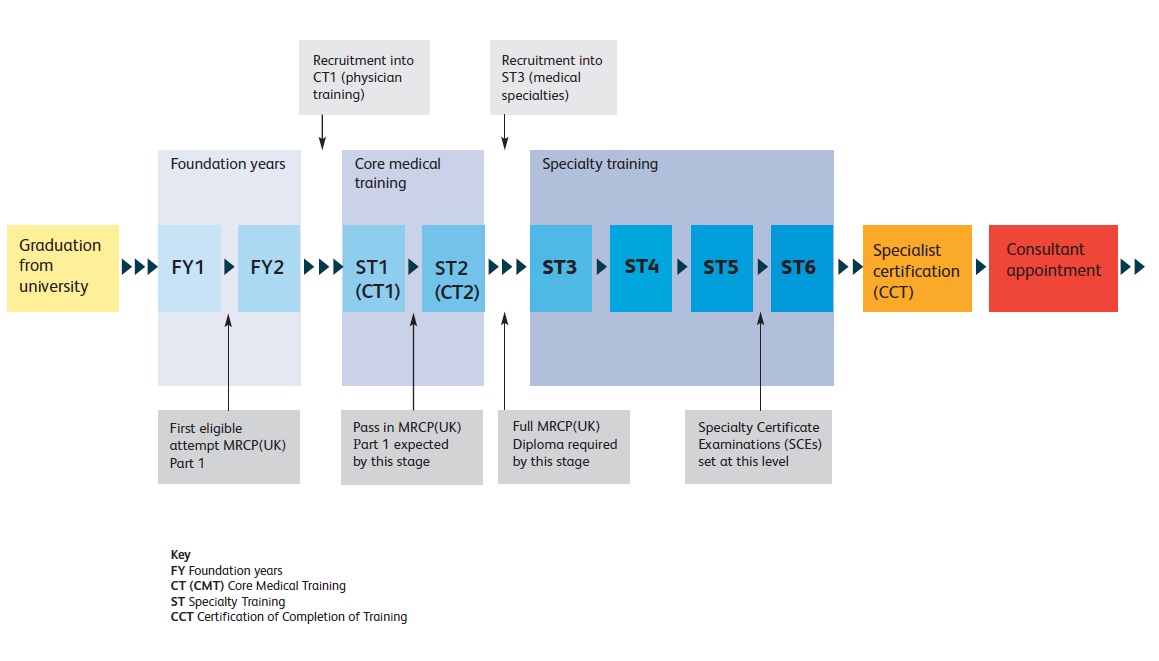
The Foundation Programme is a structured two-year training programme designed for doctors who have recently completed medical school. This programme provides practical experience across different medical specialties and serves as the first step in postgraduate medical training in the UK healthcare system.
In Foundation Year 1 (F1), doctors are provisionally registered with the GMC and must demonstrate competency in various medical skills. Upon successful completion, they become eligible for full GMC registration. In Foundation Year 2 (F2), doctors receive full GMC registration and begin to take on greater responsibility for patient care.
Core Medical Training (CMT) / Internal Medicine Training (IMT)
Core Medical Training has now been replaced by Internal Medicine Training (IMT), which is a three-year programme (previously two years under CMT). This is the initial step towards obtaining higher specialty training in medical specialties.
Entry into IMT is highly competitive. MRCP is required to progress through IMT — without MRCP, a doctor cannot enter higher specialty training in medicine.
Specialty Training in the UK
Doctors who complete specialty training become eligible for consultant positions. Specialty training programmes vary in duration and are tailored to individual specialities. Each specialty follows a curriculum set by the relevant Royal College.
Certificate of Completion of Training (CCT)
A Certificate of Completion of Training (CCT) confirms that a doctor has successfully completed a GMC-approved training programme and is eligible for entry onto the Specialist Register. This is required for consultants working in the NHS.
For IMGs, the choice between PLAB and MRCP affects their pathway to CCT. PLAB graduates must complete Foundation Training and then IMT before entering specialty training leading to CCT. MRCP holders can potentially bypass the PLAB step and enter directly into higher specialty training through the MTI route, reducing the overall time required.
PLAB Vs MRCP: Eligibility Criteria
PLAB Route
To take the PLAB exam, you need a primary medical qualification recognised by the General Medical Council (GMC) and verified by ECFMG, and proof of English proficiency — IELTS Academic with 7.5 overall and minimum 7.0 in each section, or OET with Grade B in all sections.
MRCP Route
For MRCP, you must have at least 12 months of postgraduate experience in medical employment and must hold a primary medical qualification. You must be registered with a medical regulatory authority in your country. Unlike PLAB, there is no separate English language requirement for sitting the MRCP exam — but you will need English proficiency for GMC registration separately.
GMC Sponsorship Through RCP MTI (Medical Training Initiative)
The Royal College of Physicians’ MTI scheme offers sponsorship for GMC registration and visa support to enable international medical graduates to access short-term training opportunities in the UK. This is the route many Indian doctors use to join specialty training in the UK without needing to clear PLAB.
Eligibility for RCP MTI — GMC Sponsorship
You must fulfil all of the following criteria:
You must hold a primary medical qualification recognised by the GMC and verified by ECFMG. You need a postgraduate qualification — MRCP(UK) Part 1, MD, or other higher degree in medicine or a medical subspecialty. You must have completed at least 3 years of full-time postgraduate training (including 1 year of internship and at least 1 year in the specialty in which you intend to train in the UK). You must have been in clinical practice for 3 out of the last 5 years, including the 12 months immediately before GMC registration is granted. There should be no gaps in employment. The GMC does not consider clinical observerships as clinical practice. You must possess skills, competencies, and understanding of medicine at least equivalent to a UK graduate at the end of their IMT.
The RCP cannot sponsor doctors who have previously failed the PLAB exam. This is an important point — if you have attempted and failed PLAB at any point, the GMC Sponsorship route through RCP is closed to you.
English Language Requirements for MTI
You need a minimum overall score of 7.5 in IELTS, with minimum scores of 7.0 in all categories. The scores should be obtained in one sitting. The test is valid for 2 years. OET with Grade B in all sections is also accepted.
PLAB vs MRCP — Verdict
If your goal is quick entry into NHS as a junior doctor, PLAB is your best option. If you are career-focused on internal medicine or specialisation, MRCP is the right choice. You can start with PLAB, work, gain NHS experience, then go for MRCP later — it is common and smart.
Both PLAB and MRCP offer distinct advantages, and the best option depends on your career goals. If you are a fresh medical graduate with no clinical experience, the PLAB route is the quickest way to enter the UK healthcare system. It does not require postgraduate experience, making it the best choice for those who want to start working in NHS hospitals quickly.
MRCP is better suited for doctors who already have at least one year of postgraduate experience and are aiming for specialty training, higher salary, and international recognition in internal medicine and consultant-level roles.
One thing is common to both paths: if you complete your postgraduate training in the UK, your degree is recognised by NMC India. You do not need to appear for FMGE or the upcoming NExT exam to practice in India. This is a significant advantage that many Indian doctors are not aware of.
Career Voyage has helped many Indian MBBS doctors and foreign medical graduates understand the differences between PLAB and MRCP, and choose the right pathway based on their background, experience, and career goals. To check your eligibility and get a personalised recommendation, contact Career Voyage. Call us or WhatsApp for a free consultation.
More Options for MD & MS in UK without PLAB
Frequently Asked Questions — PLAB vs MRCP
Can I take MRCP without clearing PLAB?
Yes. MRCP and PLAB are independent examinations. You do not need to pass PLAB to sit for MRCP. Many Indian doctors take MRCP directly from India after gaining 12 months of clinical experience. If you pass all three parts of MRCP, you can apply for GMC registration through the Royal College of Physicians’ MTI scheme without ever taking PLAB. However, if you have previously failed the PLAB exam, the RCP MTI sponsorship route is not available to you. [KEPT]
Which is easier — PLAB or MRCP?
PLAB is generally easier because it tests clinical competency at the Foundation Year 2 (FY2) level, which is equivalent to the level of a UK junior doctor. MRCP is a postgraduate-level exam that requires in-depth knowledge of internal medicine. MRCP pass rates for non-UK candidates are significantly lower than PLAB pass rates, especially for the PACES clinical exam. If you are a fresh MBBS graduate, PLAB is the more achievable starting point. [UPDATED]
Is PLAB being replaced by UKMLA in 2026?
The PLAB exam content has been aligned with the UKMLA (UK Medical Licensing Assessment) framework since August 2024. PLAB 1 now follows the MLA Content Map (equivalent to AKT), and PLAB 2 meets the CPSA standards. However, international medical graduates still book the exam as “PLAB” on the GMC website in 2026. The name change is expected to happen gradually in the coming years. Your preparation should focus on the updated MLA Content Map, not old PLAB materials. [NEW]
Do I need to clear FMGE or NExT if I complete PG from the UK?
No. If you complete a recognised postgraduate degree from the UK, you are exempt from FMGE and the upcoming NExT exam. The UK is one of only five countries (along with USA, Canada, Australia, and New Zealand) whose PG medical degrees are directly recognised by NMC India. This means you can practice medicine in India without clearing any additional licensing exam. This exemption applies whether you took the PLAB route or the MRCP route in the UK. For details on which UK programs qualify, contact Career Voyage. [NEW]
Can I take both PLAB and MRCP?
Yes. Many doctors take PLAB first to get GMC registration and start earning in the UK, then pursue MRCP while working in the NHS. This combined approach is financially practical — you earn a salary while preparing for MRCP — and gives you valuable UK clinical experience that helps significantly with the MRCP PACES exam. This is one of the most common pathways followed by Indian doctors in the UK. [UPDATED]
What is the total cost of PLAB vs MRCP in 2026?
PLAB costs approximately £1,270-£1,310 in exam fees (PLAB 1: ~£268, PLAB 2: ~£998). MRCP costs approximately £2,500-£3,000 for all three parts. In Indian rupees, PLAB works out to roughly Rs 2-2.5 lakh in exam fees alone, while MRCP costs approximately Rs 4-5 lakh. Travel, accommodation, visa, and coaching costs are additional for both exams. PLAB 2 and MRCP PACES both require travel to the UK, so budget for flights, stay, and a Standard Visitor Visa. [UPDATED]
Which exam leads to better salary in the UK — PLAB or MRCP?
MRCP leads to higher long-term earning potential. PLAB-route doctors start at FY2-equivalent roles with a basic salary of around £32,000-£44,000. MRCP holders can enter at ST3+ level with a basic salary starting around £43,000-£55,000. Consultants in the NHS earn between £93,000 and £126,000. While PLAB gets you earning sooner, MRCP positions you for significantly higher career growth and lifetime earnings. [UPDATED]
Is MRCP recognised in India?
Yes. MRCP is widely recognised in India as a qualification equivalent to MD in Internal Medicine. Many Indian hospitals, medical colleges, and corporate hospital chains value MRCP holders. If you return to India with MRCP, you are eligible to practice as a physician specialist. Combined with UK clinical experience, MRCP significantly strengthens your profile for senior positions in Indian healthcare. Career Voyage can help you understand how MRCP fits into your India return plans. [NEW]
How long does it take to complete PLAB vs MRCP?
PLAB can be completed within 6-12 months if you pass both parts on the first attempt. You need about 3-6 months to prepare for PLAB 1, then 2-3 months to prepare for PLAB 2 after clearing Part 1. MRCP typically takes 2-3 years to complete all three parts (Part 1, Part 2, and PACES). Most doctors prepare for MRCP alongside their clinical work, which extends the timeline. If you are working full-time, plan for at least 12-24 months for Part 1 alone. [UPDATED]
Can doctors who failed PLAB apply for GMC Sponsorship through RCP MTI?
No. The Royal College of Physicians cannot sponsor doctors who have previously appeared for and failed the PLAB exam. This is a strict eligibility criterion for the MTI scheme. If you are considering the MRCP route with GMC Sponsorship, make sure you do not attempt PLAB first and fail — it will permanently close the MTI door. If you are unsure about which route to take, get proper guidance before attempting either exam. [NEW]
Topics of Interest
PLAB or MRCS — which is better
Medical PG in UK without PLAB — complete options